Wine Literature and Media
“Where every bottle tells a story”

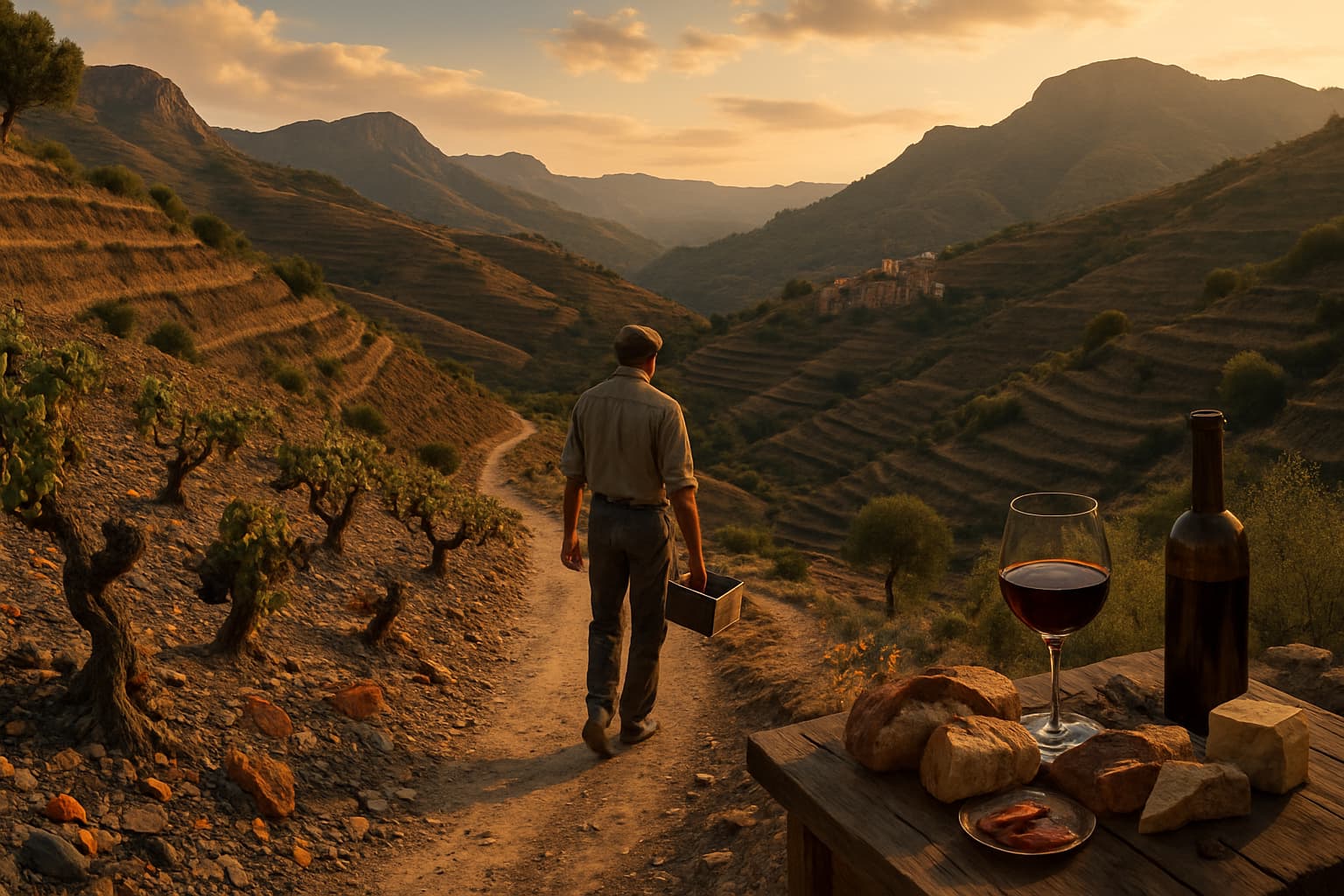
On a quiet hillside, as the sun sinks and the air cools, a vine clings to the earth with a tenacity millions of years in the making. Its roots delve deep into stone and soil, drawing up minerals that once lay in ancient seas. Its leaves drink in the fading light, transforming it into sugar and life. In the distance, a human lifts a glass, turns it thoughtfully, and takes a slow, deliberate sip. In that moment, something remarkable happens: nature’s long, patient work meets the restless curiosity of the human mind.
This is not merely drinking. It is a kind of contemplation. Wine, that most ancient of companions, has walked alongside philosophy for as long as we have recorded our thoughts. Where there is a symposium—those gatherings of conversation and debate—there is almost always a vessel of wine being passed from hand to hand. And as we shall see, the story of thinking and drinking is not one of indulgence alone, but of ritual, reflection, and a deep attempt to understand our place in the world.
Let us begin in Greece, more than two thousand years ago. Here, in courtyards lit by oil lamps, philosophers and poets reclined on couches, their voices weaving arguments and stories late into the night. At the center of these gatherings stood a simple object: the krater, a large bowl in which wine was mixed with water.
For the Greeks, drinking undiluted wine was considered barbaric, a surrender to excess and chaos. Instead, the wine was carefully watered, a symbolic act that reveals much about their view of reason and pleasure. Wine was welcome, but it had to be tamed, moderated—like desire, like anger, like fear. The symposium was not, in its ideal form, a drunken revel, but a choreography of conversation, music, and measured intoxication.
Here, Plato situates one of his most famous dialogues, The Symposium. Around the table, each guest rises to praise love—Eros—offering speeches that move from the sensual to the sublime. Yet the wine is always present, quietly shaping the atmosphere. It loosens tongues, softens rigid certainties, and allows the mind to wander into territories it might not otherwise dare to explore. Even Socrates, that stern champion of reason, is depicted as a man who can drink copiously yet remain clear-headed, as if to suggest that true wisdom is the ability to remain steadfast amid the swirling currents of pleasure.
Thus, from the very beginning, wine is not a mere backdrop to philosophy. It is a participant, a catalyst, a subtle companion to thought.
To understand why wine so naturally invites reflection, we must look more closely at what it is. At first glance, it seems simple: crushed grapes, left to ferment. But beneath this simplicity lies a quiet alchemy.
Yeasts—microscopic fungi, invisible to the naked eye—feast upon grape sugars, transforming them into alcohol and carbon dioxide. This process, fermentation, is both violent and delicate. The must roils and bubbles, heat rises, aromas bloom and change. In a matter of days or weeks, sweet juice becomes something entirely new: a liquid that can warm, relax, and alter consciousness.
For the philosopher, fermentation becomes a powerful metaphor. It is change made visible, transformation in a glass. Just as grapes become wine, so does experience become memory, and memory become wisdom—or folly. The winemaker, like the thinker, works with what is given: soil, climate, history, and chance. They cannot control everything; they can only guide, adjust, and ultimately accept that the final outcome will always bear the mark of the unpredictable.
To drink wine attentively is to be reminded of this essential truth: that we live in a world governed by both order and contingency. The vines follow the laws of biology and chemistry, yet a late frost, a sudden hailstorm, or a new pest can undo a year’s work in a single night. Similarly, our carefully constructed philosophies must confront the unruly realities of life: illness, loss, joy, and surprise.
Now, let us walk among the vines. Underfoot, the ground changes: here, a band of limestone; there, a patch of clay; further on, shards of slate glitter in the sun. The same grape variety, planted in each of these soils, will yield wines of strikingly different character. The French call this constellation of soil, climate, topography, and human tradition terroir—literally, “of the earth.”
Terroir raises a profoundly philosophical question: what makes a thing itself? A Pinot Noir from Burgundy is not merely “grape plus alcohol.” It is an expression of its place, its season, and the hands that tended it. A vineyard a few meters away, exposed to slightly more wind or a fraction less sun, may produce a wine recognizably similar yet irreducibly distinct.
In this way, wine becomes a liquid exploration of identity and difference. Just as each human being is shaped by culture, family, geography, and time, so too is each wine. No two vintages are identical; no two bottles, even from the same barrel, are perfectly the same. Each is a fleeting configuration of matter and history.
Philosophers have long wrestled with the tension between the universal and the particular. Wine offers a tangible, sensorial illustration. We speak of “Chablis” or “Riesling” as if they were singular entities, yet each glass we raise is a one-time-only occurrence, never to be replicated. In tasting, we encounter the paradox of the world: the comfort of categories, and the stubborn individuality of every instance.
Of course, to speak of wine and philosophy is also to confront the moral questions that arise whenever humans seek pleasure. Alcohol, in all its forms, can soothe and inspire, but it can also damage and destroy. The ancients knew this well. They told stories of Dionysus, the god of wine, whose gifts brought both ecstasy and madness.
Many philosophical traditions return, again and again, to the idea of moderation. Aristotle spoke of virtue as a mean between extremes: courage between cowardice and recklessness, generosity between stinginess and waste. Wine, in this light, becomes a test of character. Do we use it to enhance conversation, deepen bonds, and celebrate life? Or do we use it to escape, to numb, to forget?
Even the structure of the Greek symposium contained safeguards: the watering of wine, the presence of a symposiarch—a kind of master of ceremonies—who determined the pace of drinking. The ritual acknowledged a simple but profound truth: that to think clearly, we must respect our limits.
In an age of abundance, this lesson remains pressing. To drink thoughtfully is to recognize that pleasure, too, must be guided by care—care for our own bodies, and for the well-being of those around us. True conviviality, the joy of being together, depends not on excess, but on balance.
Consider now a person tasting wine with care. They lift the glass to the light, observing the color: pale straw, garnet, inky purple. They swirl, releasing aromatic compounds that rise to meet the nose: citrus, stone fruit, earth, smoke, herbs. They sip, letting the wine travel across the tongue, noting its acidity, its texture, its lingering finish.
To some, this may appear extravagant, even pretentious. But beneath the surface lies an exercise in attention. The taster is practicing a kind of micro-philosophy, a disciplined noticing of nuance. In a world that increasingly rushes past itself, this deliberate slowing down—this insistence on paying attention to what is actually present—can be a radical act.
Wine is also a lesson in time. A bottle from a long-ago vintage, opened today, is a message from the past: from the weather of that year, the hands that pruned those vines, the decisions made in a cellar decades ago. As it sits in the glass, it continues to change, opening, evolving, sometimes fading. We are reminded that all things, including ourselves, are in motion.
The aesthetics of wine—the language we use to describe it, the pleasure we take in its subtleties—force us to ask: what makes an experience valuable? Is it intensity? Complexity? Harmony? And can these criteria be extended beyond the glass, into the way we evaluate a life, a relationship, a society?
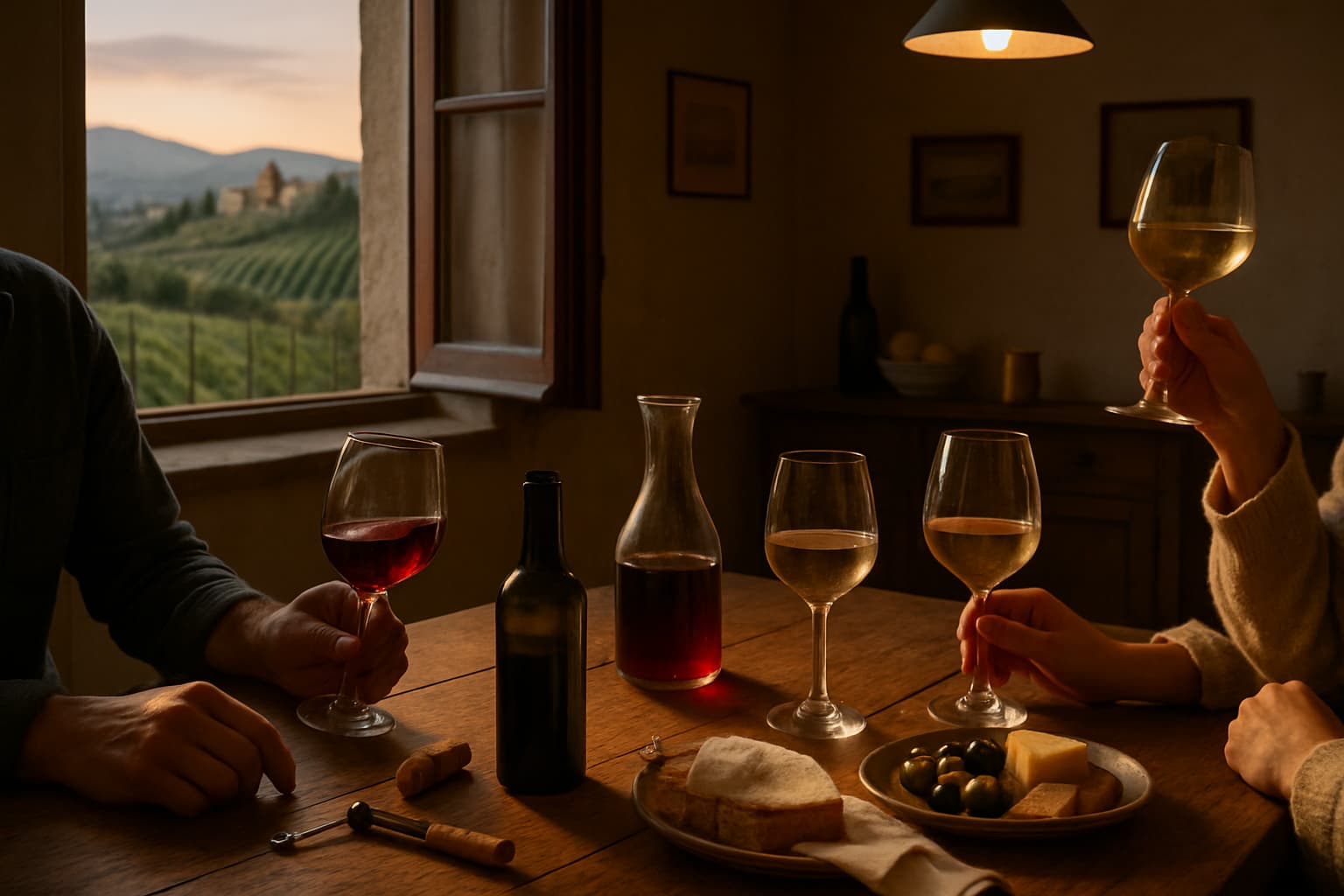
Perhaps the most enduring bond between wine and philosophy lies in their shared devotion to conversation. A single person, alone, can certainly think deeply or drink well. But when we picture philosophy at its most alive, we often imagine a table, a group, a flow of voices. Likewise, wine, for all its solitary charms, seems most at home when poured for more than one.
The passing of a bottle from hand to hand is itself a small ritual of trust and generosity. Each person receives the same wine, yet experiences it differently, filtered through their own memories and preferences. One detects cherries, another leather, another the scent of rain on hot stones. In discussing these differences, we are gently reminded that perception is not fixed, that reality is encountered through many lenses.
In this shared act, wine becomes a social philosopher. It encourages us to listen, to compare, to reflect on the gap between our inner world and that of others. It can soften defensiveness, making it easier to explore difficult topics, to admit uncertainty, to revise our views. At its best, it becomes not an escape from reality, but a companion in facing it.
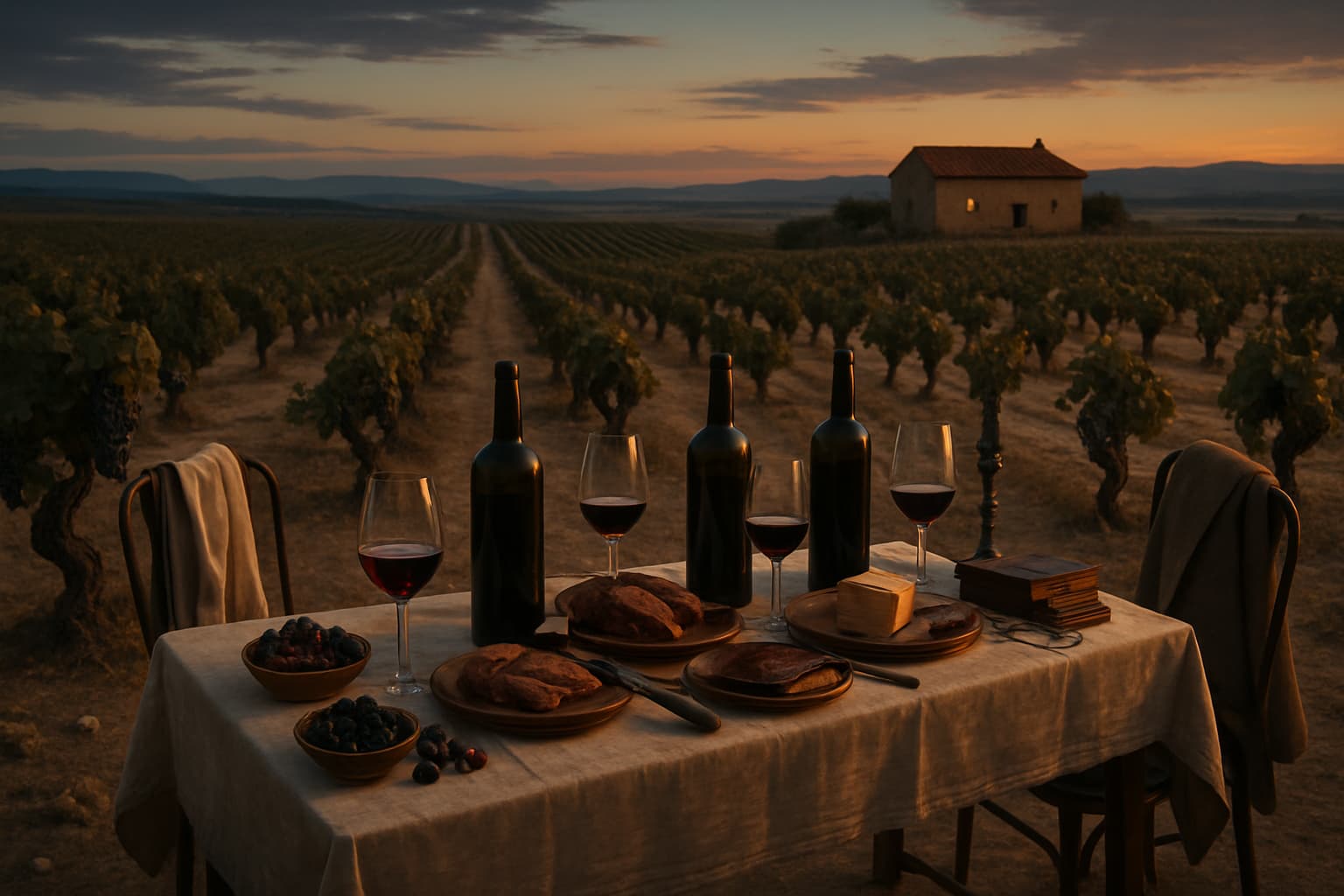
Standing at the edge of a vineyard at dusk, one senses the extraordinary patience of the earth. Vines do not hurry. They respond to seasons, to frost and thaw, to drought and rain. The people who tend them commit to cycles measured not in days, but in years and decades. A bottle produced today may be opened by someone not yet born.
In this slow dance of nature and culture, wine offers us a mirror. It shows us that we, too, are shaped by forces both within and beyond our control; that our pleasures and our thoughts are entwined; that our highest ideas are often born not in isolation, but in the company of others, with a glass in hand.
To drink wine with awareness is to acknowledge this entanglement. It is to see, in the play of light through liquid, the long story of soil and sun, of yeast and human hands, of celebration and sorrow. It is to recognize that thinking need not be dry, and that joy need not be thoughtless.
So if you choose to raise a glass, do so with care and curiosity. Attend to its origins, its character, its fleeting presence. Let it accompany your questions rather than silence them. For in that simple act—of sipping, noticing, and reflecting—you join a lineage stretching back through centuries: a quiet symposium of minds and senses, gathered around the ancient, shimmering mystery of fermented fruit and the ever-deepening wonder of being alive.
Tannins are astringent compounds found in wine that contribute to its texture and aging potential, often causing a drying or puckering sensation in the mouth. They are derived from grape skins, seeds, and stems, as well as from oak barrels used during aging.
/ˈtænɪnz/
Malic acid is a naturally occurring organic acid found in grapes that contributes to the tart, green apple-like flavor and crispness in wine. It plays a significant role in the taste and acidity of wine.
/mælɪk ˈæsɪd/
Filtration in winemaking is the process of removing solid particles from wine to clarify and stabilize it before bottling, using various types of filters to achieve different levels of clarity and remove unwanted elements like yeast, bacteria, and sediment.
/fɪlˈtreɪʃən/
Oxidation in wine is a chemical reaction between the wine and oxygen that can change its flavor, aroma, and color. This process can be beneficial or detrimental depending on the extent and context of the exposure.
/ˌɒksɪˈdeɪʃən/
Microclimate refers to the unique climate conditions of a small, specific area within a larger region, significantly influencing grapevine growth and the characteristics of the resulting wine.
/ˈmīkrōˌklīmit/
Get weekly wine recommendations, vineyard news, and exclusive content delivered to your inbox.