Wine Literature and Media
“Where every bottle tells a story”

In the cool of an early evening, as light drains gently from the sky, a hand reaches for a glass. The liquid within glows — ruby, garnet, straw-gold — catching the last warmth of the sun. It is a simple gesture, so familiar that we scarcely pause to consider it. Yet in that glass lies a story that spans millennia: of landscapes shaped and reshaped, of human communities bound together and torn apart, of ritual and rebellion, of faith and feasting.
This is not merely a drink. It is a cultural artifact, a social instrument, and a quiet witness to the unfolding drama of human civilization. To follow wine through history is to trace the very contours of society itself.
Long before wine became a symbol of celebration, it was an accident of nature. Somewhere in the Caucasus, the Levant, or the foothills of what is now Iran and Georgia, wild grapes fermented in clay pots or animal skins, perhaps forgotten in a corner. When early humans tasted the transformed juice, they encountered something extraordinary: a drink that not only nourished but altered perception, softened edges, and invited reflection — or risk.
Archaeological evidence suggests that humans were making wine at least 8,000 years ago. In Neolithic villages, clay jars lined with tartaric acid — the telltale residue of grapes — speak of deliberate production rather than chance. Here we see the first step from simple subsistence to culture: wine as a chosen, crafted companion to human life.
Very quickly, wine became more than a beverage. It became a marker of settled communities, of agriculture, of trade. To cultivate vines, one needed to stay, to tend, to observe the seasons. The vine, in its very nature, tethered humans to place and time, encouraging patience and continuity.
As societies grew more complex, wine slipped seamlessly into the realm of the sacred. It is no accident that when humans sought to speak with their gods, they often did so with a cup in hand.
In ancient Mesopotamia and Egypt, wine was reserved for elites and for the divine. The Egyptians placed jars of wine in tombs, sustenance for the journey beyond death. To offer wine was to offer something precious, carefully crafted from earth and labor.
In ancient Greece, wine became the lifeblood of religious and social life. The god Dionysus — or Bacchus, to the Romans — presided over wine, ecstasy, and transformation. His festivals, the Dionysia, were not mere revelry; they were structured chaos, a sanctioned loosening of social order that paradoxically helped sustain it. The Greeks recognized that wine could liberate the tongue, stir emotion, and reveal hidden truths. Under its influence, people spoke more freely, laughed more boldly, and, at times, confronted what they would otherwise conceal.
In Judaism, wine sanctifies: the Kiddush blessing over wine marks the beginning of the Sabbath and festivals, transforming ordinary time into sacred time. In Christianity, wine becomes even more profound: the blood of Christ in the Eucharist, a symbol of sacrifice, community, and divine presence. Here, wine is not merely consumed; it is contemplated, revered, and woven into the deepest narratives of meaning.
Thus, across cultures, wine has stood at the boundary between the earthly and the transcendent — a humble agricultural product elevated to a carrier of spiritual significance.
To understand wine’s social power, we must enter the ancient Greek symposium: a structured drinking party where men reclined on couches, cups in hand, while musicians played and philosophers debated. Wine there was measured, mixed with water, its strength controlled. To drink without restraint was considered barbaric; the point was not oblivion, but heightened conversation.
The symposium reveals a crucial truth: wine often serves as a social technology. It is a tool for easing conversation, for building trust, for negotiating status. A shared bottle creates a shared moment.
Centuries later, in Enlightenment Europe, wine filled the glasses of thinkers and revolutionaries in salons and cafés. In 18th-century Paris, intellectuals gathered over bottles of Burgundy and Bordeaux, discussing science, philosophy, and politics. Ideas that would reshape nations flowed as freely as the wine.
In Mediterranean villages, wine became the ordinary companion to daily life — poured at long tables where families and neighbors gathered to eat, argue, and laugh. In such settings, wine is not spectacle but background: a quiet thread stitching people together. Through it all, the drink itself is consistent, but the meanings attached to it shift with culture and context.
Wine has never been neutral. It has always carried the imprint of power.
In ancient Rome, fine wines were a privilege of the upper classes. Amphorae bearing the names of prized vineyards were shipped across the empire, a liquid display of wealth and connection. To offer a rare vintage was to assert status; to be served cheap wine was to be reminded of one’s place.
In medieval Europe, monasteries became guardians of viticultural knowledge. Monks in Burgundy, Champagne, and the Rhine Valley observed their vines with quasi-scientific devotion, mapping subtle differences in soil and slope. Over centuries, they identified which plots produced the most profound wines. These “climats” and “crus” would later underpin entire systems of classification. Religious institutions, through their vineyards, held not only spiritual but economic and cultural power.
As feudalism gave way to capitalism, wine production and trade became instruments of national ambition. The rivalry between French and British tastes, the rise of fortified wines like Port and Sherry as colonial commodities, and the use of wine tariffs as diplomatic weapons all reveal a drink entangled in geopolitics.
Even today, wine can signal class and aspiration. A well-curated wine list in a restaurant can intimidate or empower. Certain labels become status symbols, their value soaring beyond any purely sensory merit. In this way, wine mirrors broader inequalities in society: access, knowledge, and confidence are unevenly distributed.
Listen closely, and a glass of wine can be heard to tell a story — not in words, but in textures, aromas, and flavors. This is the story of terroir: the idea that a wine expresses the unique character of the place where its grapes were grown.
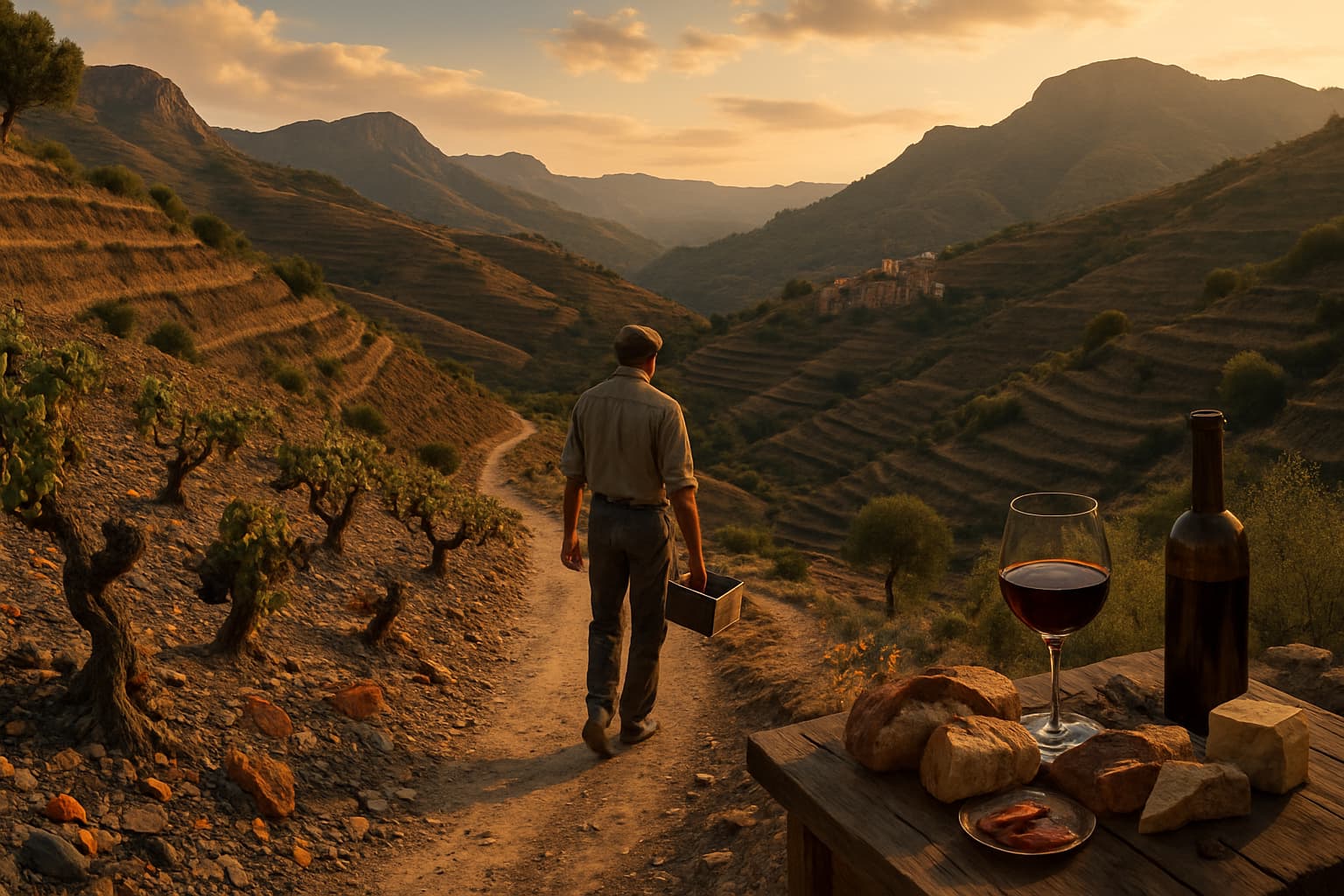
In Burgundy, a vineyard only meters away from another can produce a wine of subtly different structure and scent. In the Douro Valley of Portugal, steep schist terraces produce Port that is dense, powerful, and sweet, shaped by scorching summers and precarious slopes. In New Zealand’s Marlborough, Sauvignon Blanc seems to capture the very brightness of the southern light, bristling with citrus and green notes.
Terroir is more than geology and climate; it includes human tradition. The pruning methods passed down through generations, the choice of grape varieties, the decision to harvest early or late — all are cultural practices inscribed onto the landscape.
For many communities, wine is a core part of identity. To speak of Chianti, Rioja, or Barolo is not only to name a beverage but to invoke a region’s history, dialect, cuisine, and collective memory. When vineyards are threatened — by war, by disease, or now by climate change — it is not only an industry at risk, but a way of life.
Across centuries, artists and writers have turned to wine as both subject and symbol.
In classical poetry, wine is a muse, loosening the strictures of form and thought. The Persian poet Omar Khayyam wrote of wine as a companion in the face of life’s brevity, a reminder to savor the present. In the Bible, wine is both blessing and warning: a source of joy and of potential excess.
Painters from Caravaggio to Picasso have depicted scenes of feasting, of Bacchanalian revelry, of quiet contemplation with a glass in hand. In these images, wine represents more than thirst quenched. It stands for community, temptation, abundance, or sometimes loneliness.
In modern media, wine has acquired yet another layer of symbolism. In films and television, a character’s choice of wine can quietly signal sophistication, insecurity, or pretension. Wine critics, with their evocative language — speaking of leather, crushed violets, wet stone — create a parallel literature, half sensory description, half poetry.
Through such representations, wine lives not only on the palate, but in the collective imagination. It becomes a shorthand for pleasure, complexity, and the sometimes uneasy dance between control and surrender.
In our own age, wine has undergone a remarkable transformation. Once the preserve of specific regions and classes, it is now a global commodity and a global conversation.
Technological advances — from temperature-controlled fermentation to satellite-guided vineyard management — have made it possible to produce clean, consistent wines in places once considered inhospitable. Countries like Chile, Argentina, South Africa, Australia, and the United States have emerged as major producers, each crafting its own narratives of place and style.
At the same time, communication technologies and media have democratized wine knowledge. Blogs, podcasts, documentaries, and social platforms allow enthusiasts to share tasting notes, vineyard visits, and educational content across borders. What was once the guarded language of a few connoisseurs is now accessible to many.
Yet globalization brings tensions. International styles, often shaped by critics’ preferences and market demands, can encourage homogenization — wines from distant regions beginning to taste eerily similar. In response, a counter-movement has arisen: natural wine, low-intervention winemaking, and a renewed emphasis on authenticity and local distinctiveness.
Thus, the story continues to evolve, as societies negotiate between uniformity and diversity, efficiency and character, profit and heritage.
Amid the celebration of wine’s cultural richness, there lies a sober truth. Alcohol is a powerful substance. Throughout history, societies have grappled with its dual nature: capable of enhancing social bonds and joy, yet also of causing harm and dependency.
Religions and cultures have attempted to manage this tension in different ways: through ritualization, moderation, or outright prohibition. Even in the most wine-loving regions, traditional customs often emphasize drinking with food, with family, with time — a way of embedding restraint within pleasure.
In modern societies, where individual choice is prized and social structures are more fluid, this balance can be harder to maintain. Wine, stripped of ritual and context, risks becoming just another commodity, its deeper cultural meanings lost, its dangers overlooked.
To engage with wine thoughtfully is to acknowledge both its gifts and its risks — to see it not as an unalloyed good or evil, but as a potent cultural force that demands awareness and care.
As the climate warms, the vineyards of the world stand at a crossroads.
Grapes are exquisitely sensitive to temperature, rainfall, and seasonal rhythms. Already, regions like Bordeaux, Napa, and Barossa are experiencing shifts: earlier harvests, higher sugar levels, altered acidity. Some traditional varieties struggle; others migrate to cooler sites or higher altitudes.
New regions — in England, Scandinavia, and high-altitude zones once too cold for viticulture — are emerging. The map of wine is being redrawn before our eyes. With it, the stories, economies, and identities of wine-growing communities are in flux.
This transformation raises profound questions. What does it mean for a centuries-old region to change its grapes, its styles, its very sense of self? How do we reconcile the desire to preserve tradition with the need to adapt? And what becomes of wine’s role as a stable cultural touchstone when the climate itself is unstable?
In this, wine becomes a lens through which we can observe the broader human condition: our capacity for resilience, our attachment to place, and our responsibility to the ecosystems that sustain us.
In the end, to contemplate wine is to contemplate ourselves.
In its journey from wild vine to cultivated grape, from clay jar to crystal stemware, wine has accompanied humanity through epochs of war and peace, scarcity and abundance. It has been used to honor gods, to seal treaties, to toast weddings, to mourn the dead, and to mark the quiet, everyday miracle of a shared meal.
It reflects our ingenuity — the ability to harness yeast and time, to read the soil and the sky. It reveals our hierarchies and our aspirations, our capacity for both refinement and excess. It captures, in a single mouthful, the interplay of earth, climate, culture, and craft.
When we raise a glass, we are not merely tasting fermented grape juice. We are participating in a vast, ongoing story — one written by farmers and monks, merchants and migrants, scientists and artists, families and friends.
And as the light fades and the glass is set down, what lingers is not only the memory of flavor, but the echo of connection: to the land, to our ancestors, to one another. For in this humble, ancient drink, we glimpse the intricate tapestry of human society — and the enduring desire to find meaning, beauty, and companionship in the simple act of sharing.
Tannins are astringent compounds found in wine that contribute to its texture and aging potential, often causing a drying or puckering sensation in the mouth. They are derived from grape skins, seeds, and stems, as well as from oak barrels used during aging.
/ˈtænɪnz/
Malic acid is a naturally occurring organic acid found in grapes that contributes to the tart, green apple-like flavor and crispness in wine. It plays a significant role in the taste and acidity of wine.
/mælɪk ˈæsɪd/
Filtration in winemaking is the process of removing solid particles from wine to clarify and stabilize it before bottling, using various types of filters to achieve different levels of clarity and remove unwanted elements like yeast, bacteria, and sediment.
/fɪlˈtreɪʃən/
Oxidation in wine is a chemical reaction between the wine and oxygen that can change its flavor, aroma, and color. This process can be beneficial or detrimental depending on the extent and context of the exposure.
/ˌɒksɪˈdeɪʃən/
Microclimate refers to the unique climate conditions of a small, specific area within a larger region, significantly influencing grapevine growth and the characteristics of the resulting wine.
/ˈmīkrōˌklīmit/
Get weekly wine recommendations, vineyard news, and exclusive content delivered to your inbox.