Wine Literature and Media
“Where every bottle tells a story”
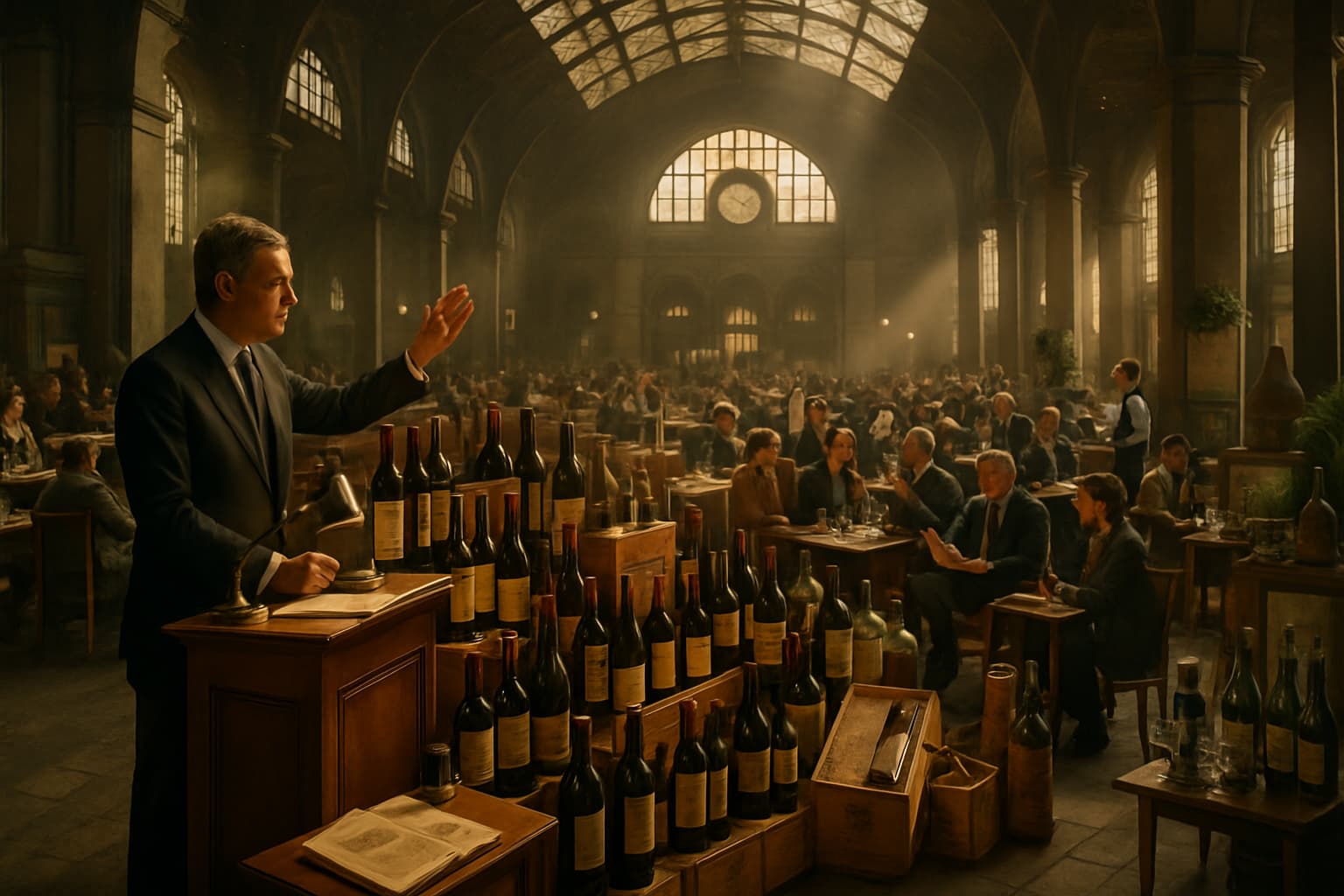
Imagine, if you will, a grand old European railway station—high ceilings, echoing footsteps, a sense that marvelous things are about to happen. Now replace the trains with bottles of Burgundy and Bordeaux, and the timetable with an auction catalog. That, dear reader, is the feeling of a proper wine auction in Europe: bustling, a bit chaotic, and absolutely thrilling.
Let’s put on our aprons, sharpen our pencils instead of our knives, and step into the fragrant, occasionally bewildering world of wine auctions and collecting—European style.
Europe, after all, is where so much of the wine story begins. The great regions—Bordeaux, Burgundy, Champagne, the Rhône, Piedmont, Tuscany, the Mosel, the Douro, Jerez—are not just names on labels; they are living, breathing places with centuries of tradition.
Wine auctions in Europe serve a few important purposes:
For the collector, an auction is both a marketplace and a classroom: you see what’s coveted, what’s fading, and what might be the next rising star.
Europe’s wine story is as old and tangled as a Burgundian vineyard map.
The modern European auction scene blends all that history with contemporary glamour: online bidding, glossy catalogs, and global participation. But under the polish, you still find the same fundamental questions: Who made the wine? From where? When? And how has it been cared for?
Like a classic French menu, the European auction world has its main courses. Let’s plate them up.
London has long been the nerve center of fine wine trading. Major international houses—Sotheby’s, Christie’s, Bonhams, and several specialized wine auctioneers—host regular sales.
Why London matters:
For a new collector, London auctions are like a grand, bustling food market: everything is there, but you need a list and a bit of discipline.
In France, auctions feel closer to the vineyards. You’ll find:
French auctions have a particular charm: the connection between place and bottle is often very direct. It’s like buying cheese in the village where it was made—you feel the terroir in the room.
Germany has a proud auction tradition, especially for high-end Riesling:
Austria, too, has seen growing interest in auctions for top Grüner Veltliner and Riesling, particularly from the Wachau and Kamptal.
Italy and Spain traditionally saw more private or local trading, but formal auctions have blossomed:
An auction can feel as intimidating as walking into a French kitchen for the first time, but once you understand the rhythm, it’s quite manageable.
The catalog is your menu, cookbook, and map all in one. It typically includes:
Like reading a recipe, you must pay attention to the details. A 1982 Bordeaux from pristine château-cellar stock is a different creature from a 1982 that’s been wandering Europe for decades.
Before the sale, you can often:
Key things to consider:
Think of it as checking your ingredients before cooking: no one wants to start a soufflé with rotten eggs.
You can usually bid:
It’s terribly easy to get carried away, especially when others are waving paddles with abandon. Set a firm budget per lot—rather like deciding how many slices of cake you’ll allow yourself.
When the auctioneer shouts “Sold!” (or the local equivalent), the hammer price is set. But that’s not your final cost.
You’ll typically pay:
Always read the conditions of sale carefully. Nothing sours a delightful bargain like unexpected fees.
Collecting wine in Europe has a particular flavor—like cooking with butter instead of margarine.
European collectors often:
A French or Italian collector might have a cherished run of vintages from a single château or domaine, like a cook who keeps every edition of a beloved cookbook.
In Europe, wine is still very much a table companion. Many collectors are also enthusiastic drinkers:
A well-curated cellar is like a pantry: meant to be used, not merely admired.
While the headlines go to grand cru Burgundy and first growth Bordeaux, European collectors often:
This diversity is one of Europe’s greatest strengths: you can build a cellar that’s as eclectic as a well-stocked spice rack.
Let’s roll up our sleeves and get practical. How does one start—or refine—a collection with a distinctly European sensibility?
Ask yourself:
A good rule of thumb: Aim for a majority of wines you genuinely want to drink, with a smaller portion of “investment-grade” bottles if that interests you.
Before chasing unicorn bottles at auction, get comfortable with:
This foundation helps you recognize value and avoid overpaying for mere fashion.
For your early auction forays:
It’s like learning to roast a chicken before tackling a multi-layered croquembouche.
Consider a three-tier approach:
Auctions are marvelous for tiers 1 and 2; local merchants, tastings, and travel often help with tier 3.
Track:
Over time, this becomes your own private “tasting cookbook,” showing you which wines age well in your conditions and suit your palate.
Just as a soufflé can collapse, wine collecting has its hazards.
If something seems too good to be true—say, a suspiciously inexpensive old DRC or Petrus—it probably is. Trust your instincts and the reputations of established houses.
At the end of the day, wine is meant to be opened, poured, and enjoyed—preferably with good food and better company.
A few European-inspired habits:
Think of your cellar as a menu you’re always refining, tasting, and revising.
Wine auctions and collecting in Europe are not just about money and prestige. They are about continuity—linking past and present, vineyard and table, tradition and curiosity.
To navigate this world:
So, sharpen your pencil, pour yourself a modest glass of something agreeable, and start browsing those catalogs. With a bit of study and a dash of courage, you’ll find that the European wine auction world, like a good kitchen, is open to anyone willing to learn, taste, and enjoy. Bon appétit—and santé!
Tannins are astringent compounds found in wine that contribute to its texture and aging potential, often causing a drying or puckering sensation in the mouth. They are derived from grape skins, seeds, and stems, as well as from oak barrels used during aging.
/ˈtænɪnz/
Malic acid is a naturally occurring organic acid found in grapes that contributes to the tart, green apple-like flavor and crispness in wine. It plays a significant role in the taste and acidity of wine.
/mælɪk ˈæsɪd/
Filtration in winemaking is the process of removing solid particles from wine to clarify and stabilize it before bottling, using various types of filters to achieve different levels of clarity and remove unwanted elements like yeast, bacteria, and sediment.
/fɪlˈtreɪʃən/
Oxidation in wine is a chemical reaction between the wine and oxygen that can change its flavor, aroma, and color. This process can be beneficial or detrimental depending on the extent and context of the exposure.
/ˌɒksɪˈdeɪʃən/
Microclimate refers to the unique climate conditions of a small, specific area within a larger region, significantly influencing grapevine growth and the characteristics of the resulting wine.
/ˈmīkrōˌklīmit/
Get weekly wine recommendations, vineyard news, and exclusive content delivered to your inbox.