Wine Literature and Media
“Where every bottle tells a story”
You don’t really get wine until you’ve seen behind the label.
Not the Instagram version. Not the “notes of crushed violets and boysenberry” nonsense. The real thing: the sweat, the rot, the arguments in cold cellars at 2 a.m., the bank loans, the hailstorms, the mold, the quiet panic when a fermentation goes sideways and nobody wants to say it out loud.
The label is a promise, a costume. Behind it is a whole ecosystem of people, history, accidents, and compromises. That’s where wine gets interesting—where it stops being a lifestyle accessory and becomes a living, fermented biography of a place and the people stubborn enough to bottle it.
So let’s go backstage.
Pick up a bottle in a supermarket. Front label: elegant script, family crest, maybe an illustration of a château or a hill. It whispers: “Tradition. Quality. You can trust me.”
It’s also marketing.
Every word on that label has been chosen to manipulate you. “Reserve.” “Estate bottled.” “Old vines.” “Handcrafted.” Half of it is legally meaningless; the other half is legally precise but emotionally misleading.
The label is the Tinder profile. Behind it is the person who shows up late, smells like sulfur and wet cellar, and starts talking about malolactic fermentation.
That’s the person you want to meet.
Before stainless steel, oak barrels, and Instagram sommeliers, there’s dirt. Always the dirt.
Wine people call it “terroir,” because French words make everything sound deeper and more spiritual. Strip away the mysticism, and terroir is just: place.
Behind the label is a patch of land someone either inherited, bought with terrifying debt, or clawed from nowhere. They spend all year out there, often in weather that would send most of us running back to the couch.
You see “2019” on a label. They see:
Wine is farming with a PR department. But the farming always comes first.
Behind every “family-owned estate” blurb is…an actual family. Or what’s left of one after a generation or two of trying to make a living off fermented grape juice.
You’ve got:
The stubborn old-timer The one who still prunes by hand, knows every vine like a relative, and thinks stainless steel tanks are a passing fad.
When you drink a bottle, you’re drinking their arguments, compromises, and occasional acts of defiance. You’re drinking their good years and bad years. Their divorces. Their hailstorms. Their decisions at 3 a.m. when the ferment smelled “off” and they had to choose between dumping a tank or gambling on a fix.
The label will tell you the grape variety and the region. It will not tell you that fermentation is controlled chaos.
Here’s what’s really happening behind that neat script:
You see “fermented in stainless steel” or “aged in French oak” on the back label. What it doesn’t say is:
Winemaking is a series of small, imperfect decisions made by tired people under time pressure. The miracle is not that so many wines are bad. The miracle is that so many are drinkable at all.
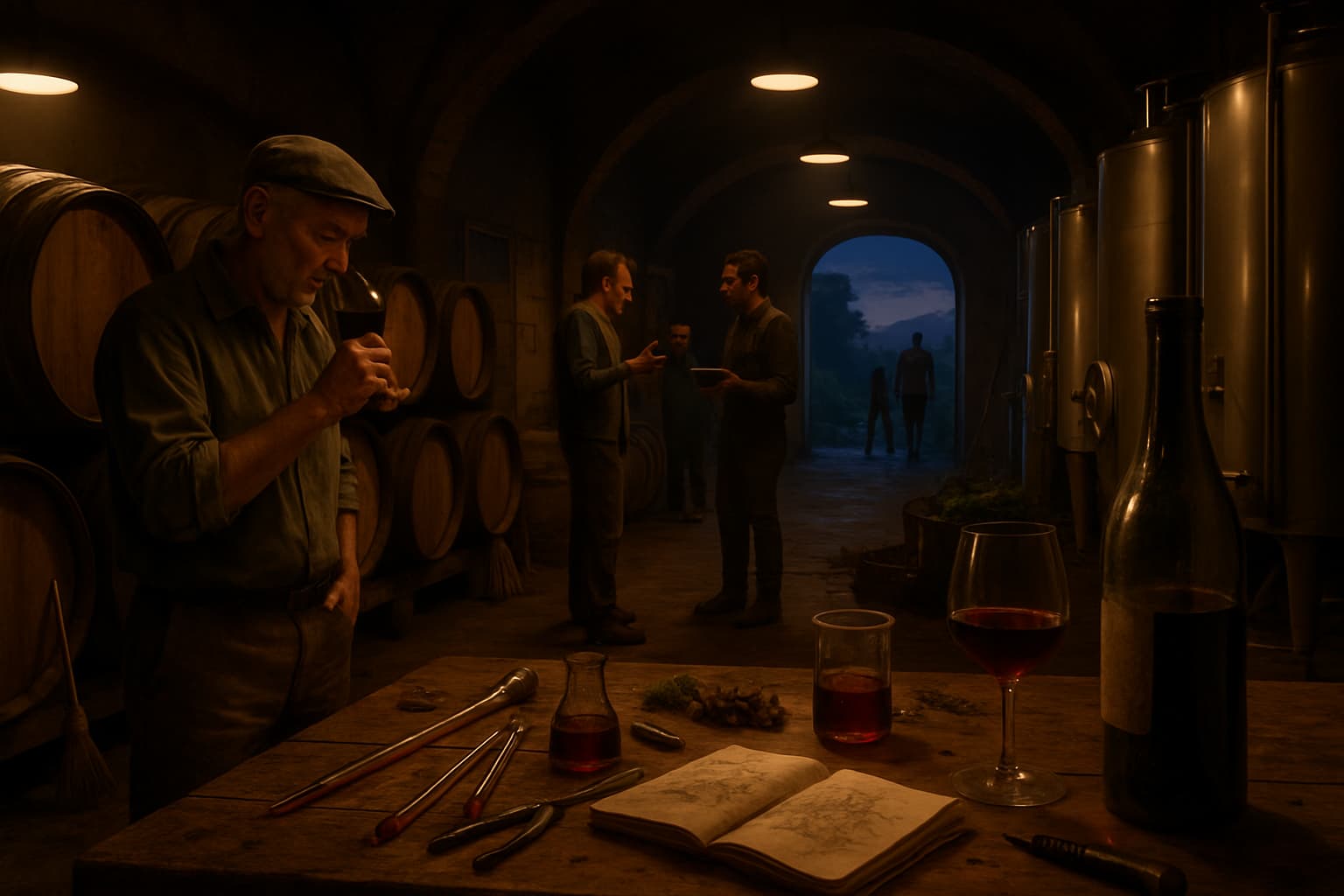
The label might brag about “12 months in French oak” or “extended lees aging.” That’s the sanitized version. The cellar is where winemakers lie awake worrying.
Barrels leak. Tanks get contaminated. Brettanomyces (a yeast that smells like barnyard and band-aids) sneaks in and turns your elegant Pinot Noir into a petting zoo.
Behind the label:
Every number you see—months in barrel, time on lees, date of bottling—is the end point of a story full of doubt and second-guessing. No one prints that on a label:
“We bottled this two weeks earlier than we wanted because the bank called.”
But you can taste those decisions, if you pay attention.
Wine doesn’t exist in a vacuum; it exists in a world of distributors, critics, importers, and trends. That world leaves fingerprints all over the label.
A few realities:
Behind the label is a spreadsheet. A sales forecast. A conversation that starts with, “We love this wine, but can you make it a little more…” and ends with something that still resembles the original idea, but with some edges sanded off.
Some winemakers hold the line. Others bend. Most dance somewhere in between, trying not to go broke while still being able to look at themselves in the mirror.
Wine literature loves purity. Noble terroir. Unbroken tradition. The heroic artisan.
Reality is messier:
Behind the label is a balancing act between:
The best wines are honest about this tension, even if the label never is. They taste like a place—but also like a decision. A line in the sand: This far we compromise. No further.
If you want to see behind the label, stop treating it like a decorative sticker and start treating it like a crime scene.
Look for:
Specific place, not just country
“Bourgogne” is something. “Gevrey-Chambertin” is more. “Single vineyard” from a named lieu-dit? Now we’re talking. Specifics usually mean someone cares.
Then, most importantly: ignore half of it and taste the wine.
That’s the only rating that matters.
Wine literature and media are supposed to help you see behind the label. Sometimes they do. Often, they just become another kind of label.
But there’s a better side to wine media too:
The good stuff doesn’t just describe the label. It rips it off and hands you the bottle, warts and all.
Behind the label is a chain of human decisions, accidents, and obsessions that runs from a patch of dirt to your glass. You don’t need to memorize appellations or fake your way through tasting notes to appreciate that. You just need to understand that:
You can drink wine like soda—cold, anonymous, background noise. Or you can drink it like a story with a cast of characters who never make it onto the front of the bottle.
Next time you pour a glass, pause for half a second. Turn the bottle around. Read the small print. Look up the producer. Ask who picked the grapes, who made the decisions, who risked their year—and sometimes their sanity—on this liquid in your glass.
Then taste it with that in mind.
Because once you’ve seen behind the label, you can’t go back. And honestly, you wouldn’t want to. The wine might not get prettier. But it will get a hell of a lot more real.
Tannins are astringent compounds found in wine that contribute to its texture and aging potential, often causing a drying or puckering sensation in the mouth. They are derived from grape skins, seeds, and stems, as well as from oak barrels used during aging.
/ˈtænɪnz/
Malic acid is a naturally occurring organic acid found in grapes that contributes to the tart, green apple-like flavor and crispness in wine. It plays a significant role in the taste and acidity of wine.
/mælɪk ˈæsɪd/
The idealistic kid fresh from oenology school
Armed with lab data, spreadsheets, and big ideas about native yeasts and low-intervention winemaking. Wants to change everything. Yesterday.
The exhausted middle generation
Stuck between tradition and survival. Knows the market wants clean, consistent wines, but also knows their father will die before letting them pull out that useless plot of ancient, low-yielding vines.
The invisible workforce
Migrant pickers, vineyard workers, cellar hands. The people who actually touch the vines, haul the crates, clean the tanks, drag hoses, and deal with the sticky, cold, back-breaking reality of harvest. They never make the label. They should.
A producer name you can trace
Can you look them up and find more than marketing fluff? Do they tell you about vineyard work, yields, farming practices? Or is it all sunsets and wine glasses?
Honest technical info
Vintage, grape variety, region, alcohol level, maybe something about fermentation or aging. If they share real details, odds are they’re not just selling you a lifestyle.
Importers and distributors with a point of view
Some importers are filters. If you trust their taste, the label becomes a breadcrumb trail.
Filtration in winemaking is the process of removing solid particles from wine to clarify and stabilize it before bottling, using various types of filters to achieve different levels of clarity and remove unwanted elements like yeast, bacteria, and sediment.
/fɪlˈtreɪʃən/
Oxidation in wine is a chemical reaction between the wine and oxygen that can change its flavor, aroma, and color. This process can be beneficial or detrimental depending on the extent and context of the exposure.
/ˌɒksɪˈdeɪʃən/
Microclimate refers to the unique climate conditions of a small, specific area within a larger region, significantly influencing grapevine growth and the characteristics of the resulting wine.
/ˈmīkrōˌklīmit/
Get weekly wine recommendations, vineyard news, and exclusive content delivered to your inbox.