Wine Literature and Media
“Where every bottle tells a story”
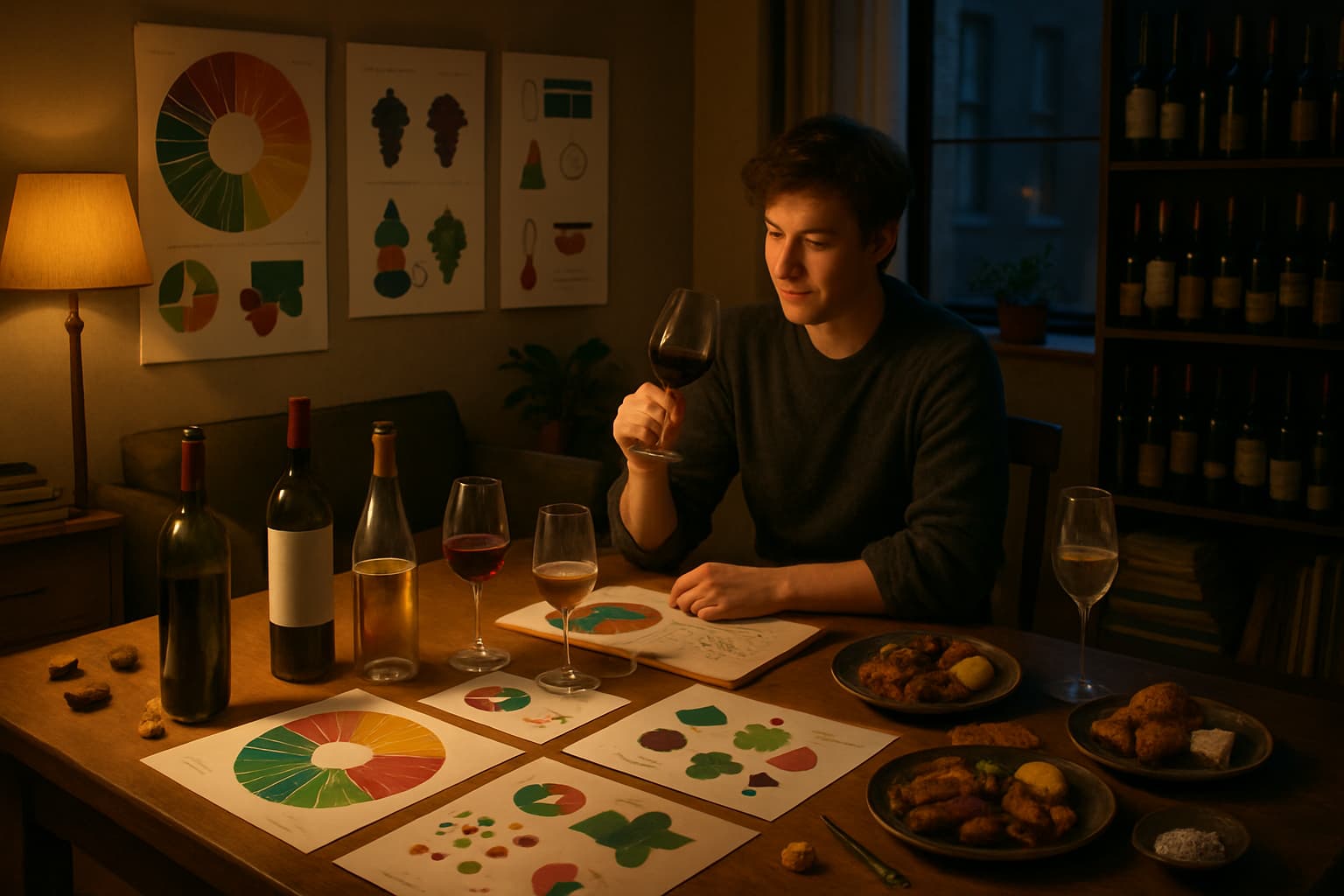
There comes a moment in every drinker’s life when beer won’t cut it, whiskey feels like a threat, and some deranged voice in the back of your skull whispers: “Maybe it’s time to understand wine.” Not just drink it—understand it. That’s when the panic sets in. Shelves of bottles leer at you like an army of glass grenades, labels in foreign tongues, tasting notes that sound like the diary of a perfumed lunatic: “Hints of wet stone, crushed violet, gooseberry, and regret.”
Most people back away. They grab the second-cheapest bottle and pray. But some poor bastards decide to go deeper. They want a map to this fermented madness. And that’s where the phenomenon of Wine Folly kicks down the door.
This isn’t some dusty, leather-bound scripture written by a French count with a monocle and a disdain for your existence. It’s a modern field manual for civilized intoxication—graphic, colorful, and dangerously accessible. It doesn’t just tell you what wine is; it wires the knowledge directly into your nervous system with charts, visuals, and enough hard data to make a sommelier weep into his Riedel glass.
Let’s walk through the vineyard with the safety off.
Wine has always had a problem: it’s been hijacked by priests of pretension. Secret handshakes. Sacred vocabularies. The unspoken rule that you must never, under any circumstances, admit you don’t know what “tannin structure” means.
The quiet revolution of Wine Folly is that it treats wine less like a religion and more like a skill—something you can learn, diagram, decode. It drags wine out of the cathedral and into the garage, lays it on the table, and starts taking it apart with infographics and color wheels.
This is wine education stripped of ceremony and inflated ego. It’s not dumbing down; it’s de-mystifying. There’s a difference. Dumbing down removes complexity. De-mystifying gives you the tools to handle it without losing your mind.
The central trick—and the genius—of this kind of guide is visual thinking. Most wine books read like legal documents written by poets: dense, romantic, and borderline unusable when you’re staring at a wine list under dim restaurant lighting.
Here, everything is weaponized into visuals:
The result is that wine stops being a fog of vague impressions and becomes a system. A messy, sensual, organic system—but a system nonetheless.
To understand wine, you start with the grapes—the prime offenders. A guide like this doesn’t treat them as abstract concepts; it treats them like characters in a deranged cast.
A serious guide doesn’t just list these grapes. It shows:
Patterns emerge. You start to realize you’re not just memorizing trivia; you’re building a mental model.
Wine is geography in a bottle—climate, soil, altitude, and human stubbornness. A proper guide makes that clear, not with romantic clichés about “terroir” whispered into the wind, but with maps and logic.
Old World vs. New World
Cool vs. Warm Climates
A good wine guide doesn’t just say “France is important.” It shows how Burgundy is the church of Pinot Noir and Chardonnay, how Bordeaux runs on Cabernet and Merlot, how the Rhône is a Syrah and Grenache playground.
Then it flips you over to the New World:
You begin to see wine not as a random global mess, but as a climate-driven conspiracy.
Here’s where most people lose their minds: tasting. The ritual. The swirl, sniff, sip, spit—if you’re a coward—or swallow, if you came here to live.
A strong, practical guide does not encourage you to babble about “whispers of honeysuckle on a distant Tuscan breeze.” It gives you a method:
And most importantly: you’re encouraged to write it down. Not for Instagram glory, but for pattern recognition. You discover that you keep falling for high-acid whites, or that big, oaky reds make you feel like you’re drinking lumber.
Now you’re not just drinking—you’re learning your own taste profile. That’s the real heresy: knowledge that leads to independence.
Wine pairing is where fear really kicks in. One wrong move and you’re the barbarian who ordered a tannic red with delicate fish. The horror.
The modern, visual-first wine guide cuts through the terror with a few core principles and diagrams you can actually remember:
Instead of memorizing a sacred scroll of pairings, you learn the physics of flavor. Once you understand the rules, you can break them with intent instead of ignorance.
Most wine crimes happen not in the vineyard, but in the kitchen. The bottle survives years of careful growing, fermentation, and aging, only to be murdered by bad temperature and worse glassware.
A practical guide lays down the law:
Serving temperatures
And storage? Keep it cool, dark, and horizontal if it has a cork. Don’t cook it on the counter. Don’t let it bake in the car. Wine is not a soldier; it’s a delicate, fermented hostage of temperature.
Beneath all the diagrams and maps, there’s an unspoken manifesto: wine should be accessible without being stripped of its soul.
The danger with any simplification is that you flatten the magic, turn wine into a sterile flowchart. But the better kind of guide acknowledges the chaos. It says:
This is the gonzo heart of it: wine as an adventure, not an exam. You’re not trying to impress anyone; you’re trying to tune your senses, to understand why one glass makes you feel like a god and another like you’ve been tricked by a decorative candle.
We live in an era where you can drown in information and die of ignorance at the same time. Infinite ratings, endless content, algorithmic recommendations. You can scroll yourself into paralysis.
A tight, visual, well-structured wine guide cuts through that static. It gives you:
Once you have that, you’re dangerous. You can walk into a wine shop, look at the shelves, and decode them. You can talk to a sommelier without fear. You can experiment without blind guessing.
You’re no longer a victim of the second-cheapest-bottle strategy.
Wine is one of the last legal, socially celebrated ways to alter your consciousness in public. It’s also a liquid archive of climate, culture, and human obsession. Approached wrong, it’s a maze of snobbery and confusion. Approached with the right guide, it’s a lifelong expedition.
A book or resource that fuses bold visuals, clear structure, and unapologetically practical information turns wine from an intimidating ritual into a navigable universe. It gives you the tools but leaves the madness—your preferences, your discoveries, your late-night bottles and bad decisions—intact.
In the end, you don’t need to become a sommelier or memorize every appellation in France. You just need to understand the basics well enough to improvise—to look at a bottle and have a rough idea of what it’s going to do to your mouth and your evening.
From there, it’s all experimentation: corks popping, glasses clinking, notes scribbled on the backs of receipts. Some wines will be transcendent. Some will be regrettable. All of them will teach you something.
And that’s the real lesson: wine isn’t a test to pass. It’s a wild, ongoing conversation between your senses, the earth, and the people deranged enough to ferment its fruit.
Get yourself a map, learn the patterns, then go off the rails. The bottle is waiting.
Tannins are astringent compounds found in wine that contribute to its texture and aging potential, often causing a drying or puckering sensation in the mouth. They are derived from grape skins, seeds, and stems, as well as from oak barrels used during aging.
/ˈtænɪnz/
Malic acid is a naturally occurring organic acid found in grapes that contributes to the tart, green apple-like flavor and crispness in wine. It plays a significant role in the taste and acidity of wine.
/mælɪk ˈæsɪd/
Glassware
You don’t need a separate glass for every sainted grape, but shape matters:
Filtration in winemaking is the process of removing solid particles from wine to clarify and stabilize it before bottling, using various types of filters to achieve different levels of clarity and remove unwanted elements like yeast, bacteria, and sediment.
/fɪlˈtreɪʃən/
Oxidation in wine is a chemical reaction between the wine and oxygen that can change its flavor, aroma, and color. This process can be beneficial or detrimental depending on the extent and context of the exposure.
/ˌɒksɪˈdeɪʃən/
Microclimate refers to the unique climate conditions of a small, specific area within a larger region, significantly influencing grapevine growth and the characteristics of the resulting wine.
/ˈmīkrōˌklīmit/
Get weekly wine recommendations, vineyard news, and exclusive content delivered to your inbox.