Wine Literature and Media
“Where every bottle tells a story”

The first time you taste a wine that stops you, you remember it.
Not the label. Not the score in some magazine.
You remember the feel of it. The way it cuts or glides.
The way it hangs on the tongue like a story you don’t want to end.
Behind that one glass stands a grape.
Behind that grape stands a family of grapes, a tribe, an army.
Not a dozen. Not a hundred,
but more than a thousand different vine varieties, each with its own temper, its own scars, its own way of surviving heat and frost and human hands.
This is a book about them.
Not about romance on the label or the lies on the back of the bottle,
but about the blood of the thing itself.
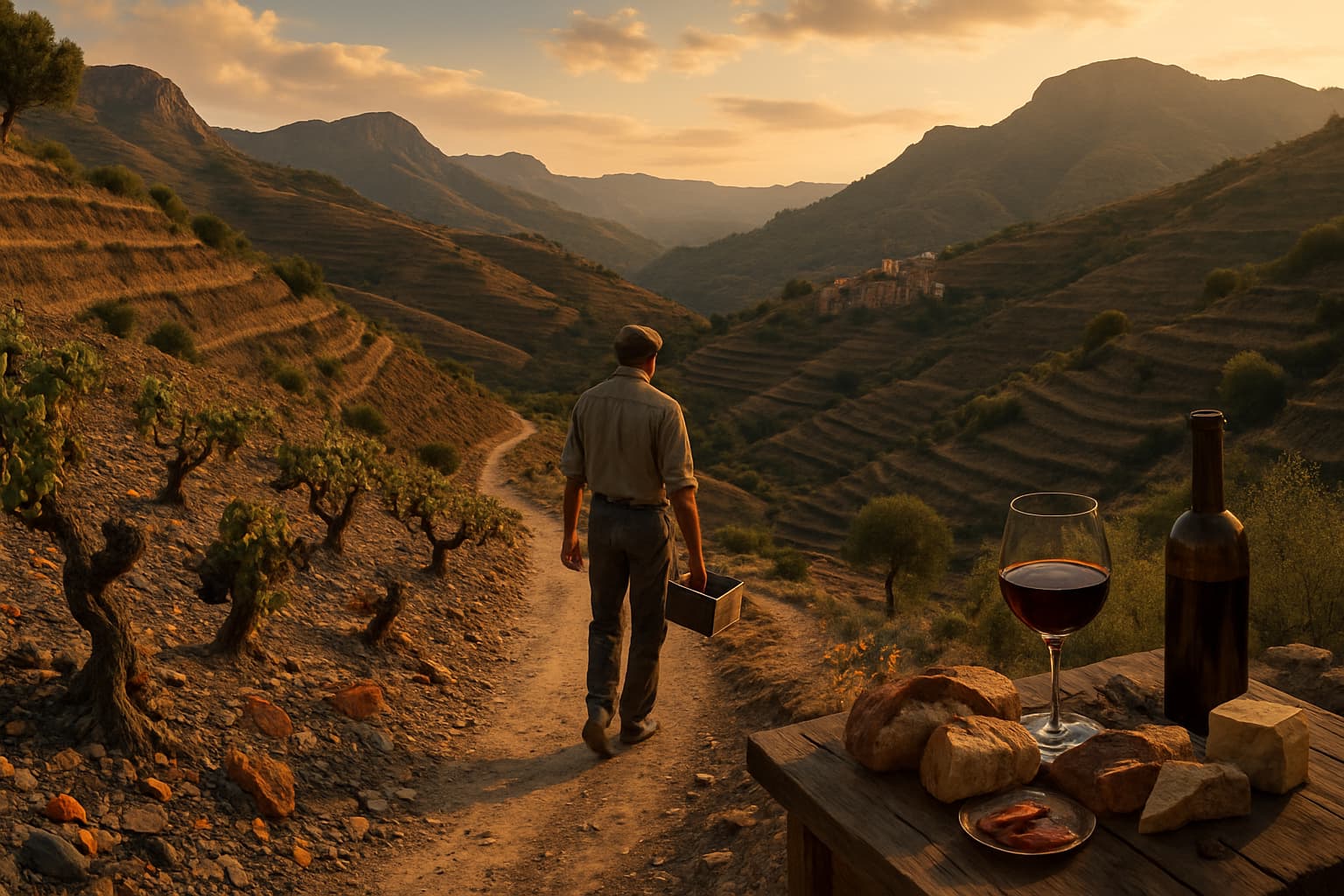
Walk a vineyard at dawn and you see how small you are.
Rows run like lines in a notebook, but every vine is different.
Some cling to poor stone and dust.
Some drink from deep, cool clay.
Some are old and twisted, black wood against the sky.
Some are young and eager, all green reach and promise.
Wine is geography in a glass.
But before the soil and the wind and the hand of the grower, there is the variety.
Cabernet. Pinot. Riesling. Tempranillo.
Names that sound like towns you once passed through, or people you almost loved.
Still, these are only the famous ones.
They are the generals in a war fought by 1,368 small soldiers.
This great catalog of grapes shows you the rest of the army:
the forgotten, the rare, the stubborn survivors,
the grapes that never make the front label but shape the wine all the same.
People like to talk about terroir.
They say the soil speaks. The slope. The wind from the sea.
It all matters. But the vine has the final say.
A thin-skinned grape will bruise in the sun.
A thick-skinned one will stand up to heat and give you color and tannin and the taste of iron and smoke.
Some grapes ripen early and shy away from frost.
Others take their time and need a long autumn to come into themselves.
The variety is the script.
The place is the stage.
The winemaker is the director, trying not to ruin the play.
A complete guide to 1,368 vine varieties does not exist to impress you with a big number.
It exists to show you how much you have not yet tasted,
how much of the world of wine is still hidden behind a curtain of easy names:
Cabernet, Chardonnay, Merlot, Pinot Grigio.
Beyond them there is a wilderness of grapes:
Furmint, Assyrtiko, Xinomavro, Trousseau, Mencía, Nerello Mascalese, Blaufränkisch, Godello, and a thousand more.
Each has a way of speaking:
short and sharp, long and slow,
bright as lemon, dark as old leather.
Grapes are like people.
They belong to families.
Some families are loud and everywhere.
Some stay quiet in a single valley for a thousand years.
There are a few grapes everyone knows.
They sit in the front row of every wine shop.
These are the grapes that built empires:
Bordeaux, Burgundy, Napa, Barossa.
They travel well. They adapt. They make money.
But the book of 1,368 varieties is not just about these emperors.
It is about the peasants and the exiles.
In the Old World, vines took root where people stayed long enough to bury their dead.
Grapes learned to live with the place.
They became local, stubborn, proud.
Then there are the quiet ones:
The guide does not stop with the known.
It goes into forgotten valleys of Italy, where Aglianico broods in the south, dark and tannic and slow to forgive.
It walks the terraces of the Douro.
It climbs the slopes of the Alps, where Savagnin and Jacquère cling to rock and cloud.
In the so-called New World, people brought cuttings from Europe and planted them in strange light.
Chile took in Bordeaux grapes and kept them safe when phylloxera, the root louse, devoured the vineyards of France.
Argentina gave Malbec a second life.
California turned Zinfandel into a flag.
Many of these grapes had older names:
A book that tracks 1,368 varieties must follow these migrations.
It must show you how one grape changes with distance:
how a thin, nervous Pinot from Burgundy becomes richer and riper in Oregon or Central Otago,
how a sharp, stony Sauvignon Blanc in the Loire turns tropical and loud in Marlborough.
To list 1,368 vine varieties is not just to write names in a row.
It is to chase their bloodlines.
To stand in old vineyards and ask the growers what they call this grape and why.
To send leaves and shoots to laboratories and read the truth in their DNA.
Grapes have aliases like thieves:
one name in France, another in Spain, a third in some forgotten village where people still drink from jugs.
A serious guide must untangle this.
It must tell you that:
It must also tell you which grapes are truly distinct and which are just local masks,
which are parents and which are children.
You learn that Cabernet Sauvignon is the child of Cabernet Franc and Sauvignon Blanc.
That Chardonnay comes from Pinot crossing with a now-obscure grape called Gouais Blanc.
That many old field blends in Europe are crowded families of cousins and half-siblings, planted by people who never heard of genetics but knew what grew well together.
The work is patient and slow.
You walk vineyards.
You talk to old growers who remember frost years and wars.
You taste.
You take notes.
You find that some grapes are on the edge of extinction, hanging on in a single row behind a stone wall.
A complete guide does not let them vanish without a word.
You might ask why any of this matters.
You can live your life drinking Cabernet and Chardonnay and never run dry.
But you would be living in a town with one street and one bar and the same song on the jukebox every night.
The 1,368 grapes are a map of possibility.
They give you:
When you know the grapes, you can read the label like a weather report.
You see Albariño and expect salt and citrus and a wind from the Atlantic.
You see Barbera and expect bright acid and red fruit, good with fat and meat.
You see Tannat and you brace for tannin, a wine that grips your gums and does not let go.
A guide to all these varieties gives you the keys to the cellar.
You are no longer at the mercy of marketing.
You choose by grape, by style, by what you want the wine to do to you.
There is another reason to care.
The world is narrowing.
Big companies plant big grapes in big blocks.
They like consistency. They like volume.
They do not like risk.
Small, local grapes are risk.
They are hard to sell.
They do not have famous names.
They cling to steep slopes and poor soils where machines cannot go and yields are low.
Without books that name them, without people who drink them, they die.
A vine is not immortal.
It needs someone to cut it back each winter, to tie it up, to pick its fruit.
When the last old farmer pulls out his vines and plants something easy and safe, a grape can vanish from the earth.
A complete guide is a kind of resistance.
It says: This grape exists.
Here is its name.
Here is where it grows.
Here is what it tastes like.
Here is its story.
Once written, it is harder to erase.
You do not read a catalog of 1,368 grapes from front to back like a novel.
You live with it.
You keep it near the table where you open bottles.
You drink a wine from Sicily and you see Nero d’Avola on the label.
You open the book and find out it is a dark, sun-loving grape that gives black fruit and spice and sometimes a hint of salt from the sea.
You taste again and you find it.
You order a bottle of Blaufränkisch in a bar because the name sounds like a curse.
You look it up and learn it is an Austrian red, high in acid, full of dark berries and pepper.
You drink it and feel the snap of it and the way it cuts through pork and sausage.
The book becomes a companion,
not a teacher with a ruler in hand, but an old friend who knows the back roads.
You follow it down those roads.
You buy wines from grapes you cannot pronounce.
You learn.
Your tongue learns too.
In the end, all this talk of 1,368 varieties comes down to one simple thing.
You pour a glass.
You lift it.
You smell.
You taste.
The grape is there with you:
its years of sun and rain,
its struggle against rot and frost,
the hands that pruned it,
the soil that fed it.
A great guide to the world’s vine varieties does not make the wine taste better.
It makes you pay attention.
It gives names to the shadows in the glass.
It turns drinking into reading, and reading into travel.
The world is wide and often cruel.
There is war and hunger and noise.
But there is also this:
a hillside, a vine, a cluster of grapes,
crushed and changed and poured into your glass.
A thousand and more different ways for the earth to speak.
If you care to listen, you will not run out of voices in this lifetime,
not with 1,368 grapes waiting in the dark, ready to be found.
Tannins are astringent compounds found in wine that contribute to its texture and aging potential, often causing a drying or puckering sensation in the mouth. They are derived from grape skins, seeds, and stems, as well as from oak barrels used during aging.
/ˈtænɪnz/
Malic acid is a naturally occurring organic acid found in grapes that contributes to the tart, green apple-like flavor and crispness in wine. It plays a significant role in the taste and acidity of wine.
/mælɪk ˈæsɪd/
Filtration in winemaking is the process of removing solid particles from wine to clarify and stabilize it before bottling, using various types of filters to achieve different levels of clarity and remove unwanted elements like yeast, bacteria, and sediment.
/fɪlˈtreɪʃən/
Oxidation in wine is a chemical reaction between the wine and oxygen that can change its flavor, aroma, and color. This process can be beneficial or detrimental depending on the extent and context of the exposure.
/ˌɒksɪˈdeɪʃən/
Microclimate refers to the unique climate conditions of a small, specific area within a larger region, significantly influencing grapevine growth and the characteristics of the resulting wine.
/ˈmīkrōˌklīmit/
Get weekly wine recommendations, vineyard news, and exclusive content delivered to your inbox.