Wine Literature and Media
“Where every bottle tells a story”
There is a moment, somewhere between the second glass and the third, when wine stops being a polite beverage and starts telling you the truth.
Not the Hallmark truth about “notes of cherry” and “hints of oak,” but the feral, unshaven truth of soil and sweat and mold and money and madness. That’s the moment professionals chase. Not the buzz—any frat party can give you that—but the razor’s edge where pleasure meets perception and your nervous system turns into a crime lab.
This is not about “enjoying a nice red.” This is about learning to interrogate a liquid like it’s a suspect in a high-profile felony. It’s about training your senses until every glass is a dossier, every bottle a witness, every vineyard a crime scene. Wine is evidence. Your job is to build the case.
Welcome to the professional side of wine tasting. Wipe your feet. Check your ego. Spit in the bucket. Let’s work.
People like to pretend wine professionals are born with some genetic gift—an enchanted tongue, a bloodline of sommeliers, a palate blessed by Bacchus himself. Nonsense.
Professional tasting is not magic. It’s method.
The difference between an amateur and a pro is not sensitivity; it’s discipline. A pro has built a mental filing system for smell, taste, structure, and origin. They’ve smelled enough things, tasted enough things, and organized enough experiences that when a glass hits the table, they can cross-examine it with speed and accuracy.
You can train this. But you have to stop drinking wine like a civilian and start tasting it like a hostile witness.
Rule one: you are not here to be charmed. You are here to observe.
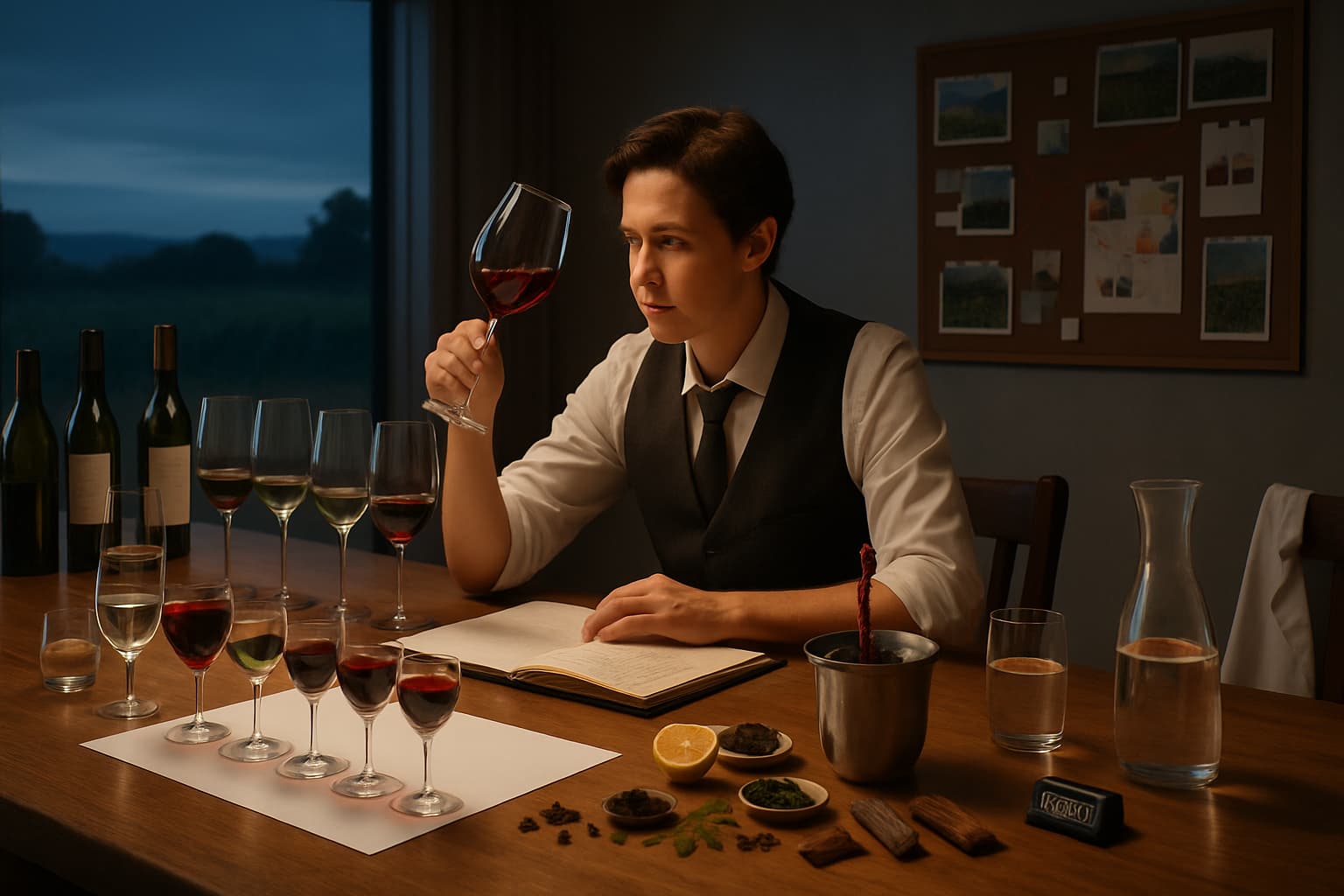
Professional tasting is a three-part conspiracy: nose, mouth, and brain. The nose is the informant, the mouth is the instrument, and the brain is the deranged detective pinning yarn to the wall.
If you’re not smelling obsessively, you’re not tasting professionally—you’re just day-drinking with extra paperwork.
Smell is where most of wine’s information lives. The tongue can handle sweet, sour, salty, bitter, umami. The nose handles everything else: fruit, flowers, earth, funk, oak, oxidation, age. Professionals know this and treat their nose like a sacred, volatile, easily offended god.
Training the nose is not glamorous. It’s weird and inconvenient and often antisocial:
Smell everything in your life like a lunatic:
The mouth confirms what the nose suspects. It’s not just about flavor; it’s about structure. Structure is the skeleton of wine: the architecture that holds all the pretty aromas together.
A professional mouth is tuned to pick up:
The mouth is not a black hole. Professionals don’t just swallow and move on. They roll the wine around, feel the texture, notice the attack, mid-palate, and finish. They ask: Does this wine come in like a trumpet and leave like a whisper? Or does it creep up quietly and then detonate?
Then—crucially—they spit. Because this is work, not a bachelorette party.
The brain is where things get dangerous. Your senses send in raw data; your brain wants to twist it into a story that matches your expectations, your biases, your mood, your hunger, your hangover.
Professional tasting means you are constantly at war with your own brain.
You blind taste not because it’s a parlor trick, but because it’s the only way to put the wine on trial without bribery. Labels are bribes. Prices are bribes. Famous regions are bribes. Your job is to resist.
The brain’s job in professional tasting:
Strip away the theater and the stemware snobbery, and professional tasting is a sequence of deliberate steps. It’s not mystical. It’s a checklist.
This is the skeleton of professional evaluation. Everything else is decoration and theater.
Wine language is a circus: graphite, wet stone, barnyard, cigar box, forest floor, cat’s pee, garrigue. It sounds insane because it is insane. But there is a method to the madness.
The goal is not poetry. The goal is communication.
Professional language is not about impressing civilians. It’s about precision among people who live in the same sensory asylum.
The wine world is a swamp of marketing, mythology, and money. Professional tasting is supposed to be the rope line between reality and fantasy.
You are not a brand ambassador. You are a witness.
The professional code—unwritten, often violated, but still the only thing standing between you and becoming a glorified influencer—goes like this:
Don’t marry regions or producers. Today’s hero is tomorrow’s disappointment. Vintage, weather, disease, hubris—everything changes.
Blind tasting is the gladiator arena of professional wine. Strip away the label, hide the price, and suddenly half the room loses its confidence and starts sweating through their suits.
Blind tasting is not about parlor tricks or party games. It’s about dismantling bias.
When you taste blind:
Professionals use structured blind-tasting grids—appearance, nose, palate, structure, conclusion—not because they love paperwork, but because the grid keeps them from hallucinating.
Pattern recognition is the endgame:
Cool climate? Warmer climate? Old World vs. New World? Young vs. mature? You’re not guessing; you’re building a chain of evidence from the glass outward.
In the category of wine literature and media, tasting is not just evaluation—it’s narrative. The way professionals describe wine shapes how the public understands it, buys it, worships it, or ignores it.
The danger: turning wine into elitist scripture.
The opportunity: turning wine into a living story.
The best writing and media about wine do three things:
Decode the complexity
They translate technical tasting into something humans can grasp without a diploma: why this wine tastes the way it does, and why that matters.
Expose the machinery
They reveal the farming, the fermentation, the economics, the risk. They show that behind every “elegant bouquet” is a farmer praying the hailstorm misses the vineyard.
Preserve the chaos
They resist the urge to sanitize. Vintage variation, flawed bottles, human error, brilliant accidents—these are not bugs; they’re features.
Professional tasting notes, when written honestly, are tiny pieces of investigative journalism. Each one answers the same questions: What is this? Where did it come from? Who made it? What went right? What went wrong? Why does it matter?
If you want to cross over from casual drinker to professional-level taster, you don’t need to sell your soul—just your comfort.
Here’s the brutal regimen:
At the end of the day—or the flight, or the lineup, or the judging panel—professional wine tasting is not about scores, or status, or Instagram trophies. It’s about attention.
Attention to the liquid. Attention to the land. Attention to the people who gamble their lives on vines and weather and yeast. Attention to your own senses, and how easily they can be tricked, seduced, or bought.
You are not here to be impressed. You are here to be awake.
Wine is fermented agriculture, bottled time, and human intention under glass. The professional taster’s job is to decode that—honestly, relentlessly, sometimes brutally—and then tell the story in a way that doesn’t insult the wine, the maker, or the reader.
So pour the glass. Stare it down. Smell like a bloodhound. Taste like a scientist. Think like a detective. Write like a lunatic with a deadline.
And above all, remember that behind every civilized sip is a wild, ungovernable chaos of nature and human ambition. Professional tasting is simply the art of looking that chaos in the eye and saying:
“Tell me everything.”
Tannins are astringent compounds found in wine that contribute to its texture and aging potential, often causing a drying or puckering sensation in the mouth. They are derived from grape skins, seeds, and stems, as well as from oak barrels used during aging.
/ˈtænɪnz/
Malic acid is a naturally occurring organic acid found in grapes that contributes to the tart, green apple-like flavor and crispness in wine. It plays a significant role in the taste and acidity of wine.
/mælɪk ˈæsɪd/
Build a scent vocabulary:
Professionals don’t just smell “fruit.” They smell red fruit vs. black fruit vs. dried fruit. They smell fresh cherry vs. stewed cherry vs. cherry jam. The more precise the language, the more precise the perception.
Respect the nose’s fragility:
Strong perfume? Enemy. Cigarette smoke? Enemy. Mint gum before a tasting? War crime. A pro walks into a tasting like a sniper: senses clean, environment controlled, distractions eliminated.
Look
Smell (Without Swirling)
Swirl and Smell Again
Taste
Finish
Conclusion
Be specific, not pretentious
“Red fruit” is better than “fruity.”
“Fresh strawberry and raspberry” is better than “nice berries.”
“Damp earth and mushroom” is more useful than “terroir vibes.”
Use metaphors with purpose
Saying “this wine is like a tight, coiled spring” tells a pro taster: high acid, youthful, tense, needs time.
Saying “this is like a velvet hammer” suggests richness and power with smooth texture.
Know the classic markers
Separate pleasure from judgment
You can admire a wine without liking it. You can love a wine that is technically flawed. A pro can say: “This is brilliantly made, but not my style,” or “This is a mess, but I’d happily drink it with friends at midnight.”
Respect context
A chilled, salty white might be perfect on a scorching beach and pointless in a quiet tasting room. A heavy, brooding red might be magnificent with steak and oppressive on its own. Professional judgment considers the battlefield, not just the weapon.
Stay suspicious
High scores, fancy labels, glowing reviews—these are all attempts to pre-load your opinion. You taste the wine in the glass, not the story on the back label.
Taste systematically
Don’t just drink a random bottle. Line up three Sauvignon Blancs from different regions. Compare. Take notes. Repeat with Chardonnay, Pinot Noir, Syrah, Riesling.
Taste with people better than you
Sommeliers, buyers, winemakers. Listen to how they talk. Watch what they notice. Steal their frameworks. Ignore their snobbery.
Write everything down
Your memory is a liar. Notes are evidence. Date, producer, region, grape, vintage, your impressions. Over time, you’ll see patterns in your preferences and your blind spots.
Taste blind regularly
Have someone else pour. Humble yourself. Be wrong often. Being wrong is how you sharpen the blade.
Stay curious, not doctrinaire
The moment you start saying “I only drink X” or “Y is always better than Z,” you’ve stopped tasting professionally and started worshipping.
Filtration in winemaking is the process of removing solid particles from wine to clarify and stabilize it before bottling, using various types of filters to achieve different levels of clarity and remove unwanted elements like yeast, bacteria, and sediment.
/fɪlˈtreɪʃən/
Oxidation in wine is a chemical reaction between the wine and oxygen that can change its flavor, aroma, and color. This process can be beneficial or detrimental depending on the extent and context of the exposure.
/ˌɒksɪˈdeɪʃən/
Microclimate refers to the unique climate conditions of a small, specific area within a larger region, significantly influencing grapevine growth and the characteristics of the resulting wine.
/ˈmīkrōˌklīmit/
Get weekly wine recommendations, vineyard news, and exclusive content delivered to your inbox.