Wine Tourism
“Where every bottle tells a story”
You don’t need another precious guide to wine that talks to you like you’re shopping for curtains. You’re not here for “notes of gooseberry” and “playful acidity.” You’re a traveler. You move. You eat what the locals eat, drink what they drink, and hope you don’t wake up missing a kidney or your passport.
Wine, for you, is not a collection of adjectives. It’s a reason to go somewhere. To stand in a place where people have been crushing grapes and making bad decisions for a thousand years. To taste something that only makes sense there, with those people, in that light.
So let’s talk about wine tasting the way travelers should: as a slightly unhinged, sensory, often boozy way to understand a place—without turning into that guy swirling his glass like he’s auditioning for a Napa soap opera.
You can go to a city, hit the big monuments, take the selfies, and leave. Or you can go where the vines are—where the land actually matters, where people obsess over weather like it’s a religion and talk about soil like it’s a lover.
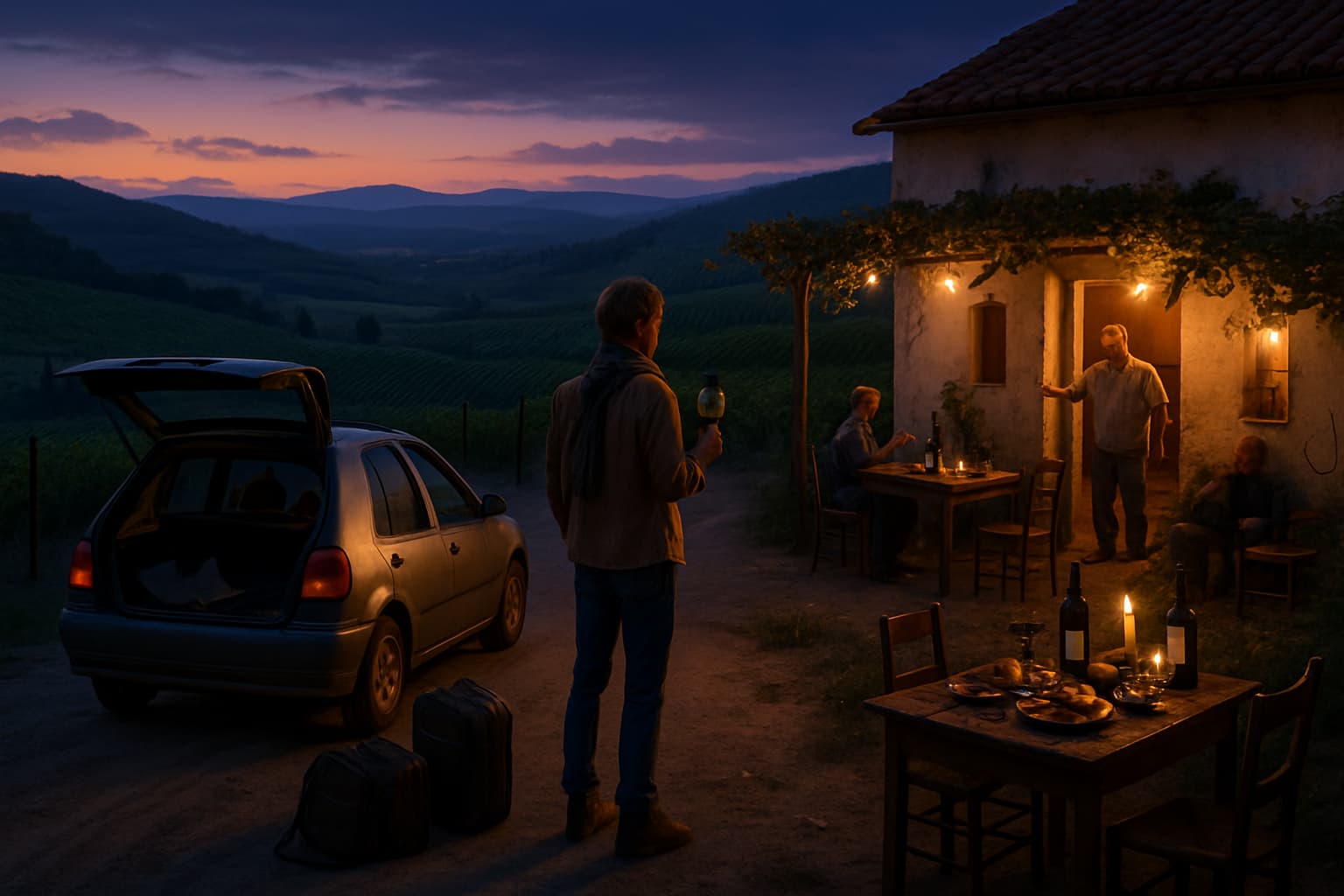
Wine regions are the opposite of airport lounges. They’re slow. Messy. Imperfect. You get lost down tiny roads. Your phone signal dies. You argue about directions in a rental car that smells like fear and sunscreen. And then you turn a corner and there it is: a valley full of vines, a beat-up farmhouse, some old guy in a stained shirt waving you in like he’s been expecting you.
Wine tasting, done right, is not a checklist of famous labels. It’s a crash course in geography, history, agriculture, and human insanity. People devote their lives to coaxing flavor out of fruit that spends its days baking in the sun and its nights worrying about frost. You show up for an hour and drink the results.
Respect that.
First rule: you’re not on a wine safari. These are not exhibits. They’re farms. Factories. Family businesses. People’s homes.
If you want to actually learn something, drop the posture. No one cares if you can pronounce “Gewürztraminer” correctly. They care if you’re curious, if you listen, if you’re not a jerk.
Bad approach:
“I only drink bold reds. Do you have anything like a Napa Cab?”
Better approach:
“What do people around here actually drink with dinner? Can I try that?”
You’re not there to impose your taste. You’re there to let the place rewire your taste buds, at least for an afternoon.
Every wine region now has its own tourism machine: glossy brochures, “Top 10 Wineries You Must Visit Before You Die,” and that one spot everyone photographs at sunset like it’s a pilgrimage site.
You can do better.
Wine makes sense with food. So flip the script:
Find the food, then find the wine that grew up alongside it. They’ve been in a long-term relationship for centuries. Don’t break them up.
Sure, go to Bordeaux, Napa, Tuscany if you must. They’re famous for a reason. But understand: you’re not the first one there. You’re not even in the first million.
Where it gets interesting is at the edges:
Big names give you polish. Lesser-known regions give you stories.
You show up at a winery. Someone pours wine in your glass. Now what?
Yeah, you can look at the color. Is it pale, dark, cloudy, clear? Great. Don’t spend five minutes staring at it like it’s going to reveal the meaning of life. It’s not.
Stick your nose in the glass. Inhale. Hard. What do you smell? Fruit? Flowers? Dirt? Barnyard? Gas station? It’s all valid. Don’t hunt for fancy words. Just ask yourself:
Sip. Swish. Swallow or spit—spitting is not a crime; it’s survival if you’re hitting more than one winery.
Ask yourself:
That’s it. That’s tasting. Everything else is performance art.
You want to be the kind of traveler they remember fondly, not as “that drunk from [insert your country here].”
Small wineries aren’t theme parks. They may be pruning, bottling, or eating lunch like normal humans. Call or email ahead. If you just show up and they still pour for you, be grateful.
You’re here to smell the wine, not your cologne. Strong scents screw up everyone’s tasting, including yours.
Wine tasting is sneaky. A little here, a little there, and suddenly you’re explaining your childhood trauma to a confused winemaker. Hydrate. Snack. Pace yourself.
If the tasting is free or cheap and you liked what you had, buy a bottle. It’s appreciation in liquid form. If you can’t carry it, ask about shipping. If you really can’t buy, at least be honest and generous with your thanks.
You want to understand a place through its wine? Pay attention to the details.
Steep terraces? Back-breaking work. Old vines twisted like arthritic hands? History in plant form. Flat, endless fields? Probably more industrial. Neither is good or bad, just different.
Is it spotless, stainless steel, high-tech? Or old, damp, with cobwebs and dusty barrels? You’re looking at philosophy made physical: control versus chaos, tradition versus innovation.
Are they talking about “market segments” and “brand positioning,” or weather and their grandfather’s vines? Again, neither is automatically better. But it tells you what they care about.
Ask questions:
You’ll learn more from that than from any label.
Drinking wine without food is like watching only the first half of a movie. You’re missing the payoff.
In wine regions, ask:
Then shut up and eat whatever they put in front of you:
Wine is not meant to be dissected alone in a sterile room under fluorescent lights. It’s meant to be drunk with food, with people, with noise.
Travel is messy. So is wine.
The wine might be flawed—corked, oxidized, just plain bad. The tour might be boring. The “charming farmhouse” might smell like mildew and broken dreams.
You roll with it.
If the wine’s off, be polite:
“I think this one might be a bit corked—could we try another bottle?”
If the experience is lame, you finish your glass, say thank you, move on. Not every stop has to be magic. Sometimes the story is: “We went to this famous place. It sucked. The wine was fine. We left.”
That’s still a story.
You don’t need to memorize regions like you’re cramming for an exam. What you want is a rough, emotional map in your head:
Is this oversimplified? Absolutely. Does it help you choose something off a wine list in a country where you barely speak the language? Also yes.
If you did it right, you won’t leave with just bottles. You’ll leave with:
Maybe you ship a case home. Maybe you just carry one bottle in your backpack, wrapped in dirty T-shirts and hope. You open it months later in your cramped apartment, with takeout, and for a second you’re back there. The light, the air, the voices. That’s the real souvenir.
Wine tasting for travelers isn’t about becoming a connoisseur. It’s about using wine as a key—a way into kitchens, onto farms, into conversations you wouldn’t otherwise have.
Go to where the vines are. Ask dumb questions. Drink what they pour. Eat what they cook. Don’t pretend to know more than you do. Don’t apologize for what you like.
You’re not there to collect tasting notes. You’re there to collect scars, stories, and a few hangovers you’ll remember fondly.
In the end, the best wine isn’t the most expensive, or the rarest, or the one with the highest score from some guy in a suit. It’s the one that tastes like somewhere, shared with someone, at a moment you couldn’t have had anywhere else.
That’s wine tasting for travelers: less worship, more living. Drink accordingly.
Tannins are astringent compounds found in wine that contribute to its texture and aging potential, often causing a drying or puckering sensation in the mouth. They are derived from grape skins, seeds, and stems, as well as from oak barrels used during aging.
/ˈtænɪnz/
Malic acid is a naturally occurring organic acid found in grapes that contributes to the tart, green apple-like flavor and crispness in wine. It plays a significant role in the taste and acidity of wine.
/mælɪk ˈæsɪd/
Filtration in winemaking is the process of removing solid particles from wine to clarify and stabilize it before bottling, using various types of filters to achieve different levels of clarity and remove unwanted elements like yeast, bacteria, and sediment.
/fɪlˈtreɪʃən/
Oxidation in wine is a chemical reaction between the wine and oxygen that can change its flavor, aroma, and color. This process can be beneficial or detrimental depending on the extent and context of the exposure.
/ˌɒksɪˈdeɪʃən/
Microclimate refers to the unique climate conditions of a small, specific area within a larger region, significantly influencing grapevine growth and the characteristics of the resulting wine.
/ˈmīkrōˌklīmit/
Get weekly wine recommendations, vineyard news, and exclusive content delivered to your inbox.