Wine Literature and Media
“Where every bottle tells a story”

It begins, as so many human stories do, with a simple act: someone, somewhere, lifts a glass to their lips. The light catches the liquid — ruby, gold, or the pale glimmer of straw — and for a brief moment, in that fragile meniscus, we glimpse something far greater than a drink. We see weather and geology, patience and craft, history and hope, all distilled into a single sip.
Wine is not merely a beverage. It is a living archive of landscapes and cultures, a dialogue between humanity and the natural world that has been unfolding for thousands of years. To understand wine is to listen to that dialogue — to hear the whisper of ancient soils, the murmur of fermenting cellars, and the chorus of voices that have praised, debated, and documented it across the ages.
In this essential guide, we will journey through that world: from sunlit vineyards to shadowed cellars, from the fundamentals of grape and terroir to the rich body of literature and media that has grown up around wine. Let us begin our exploration.
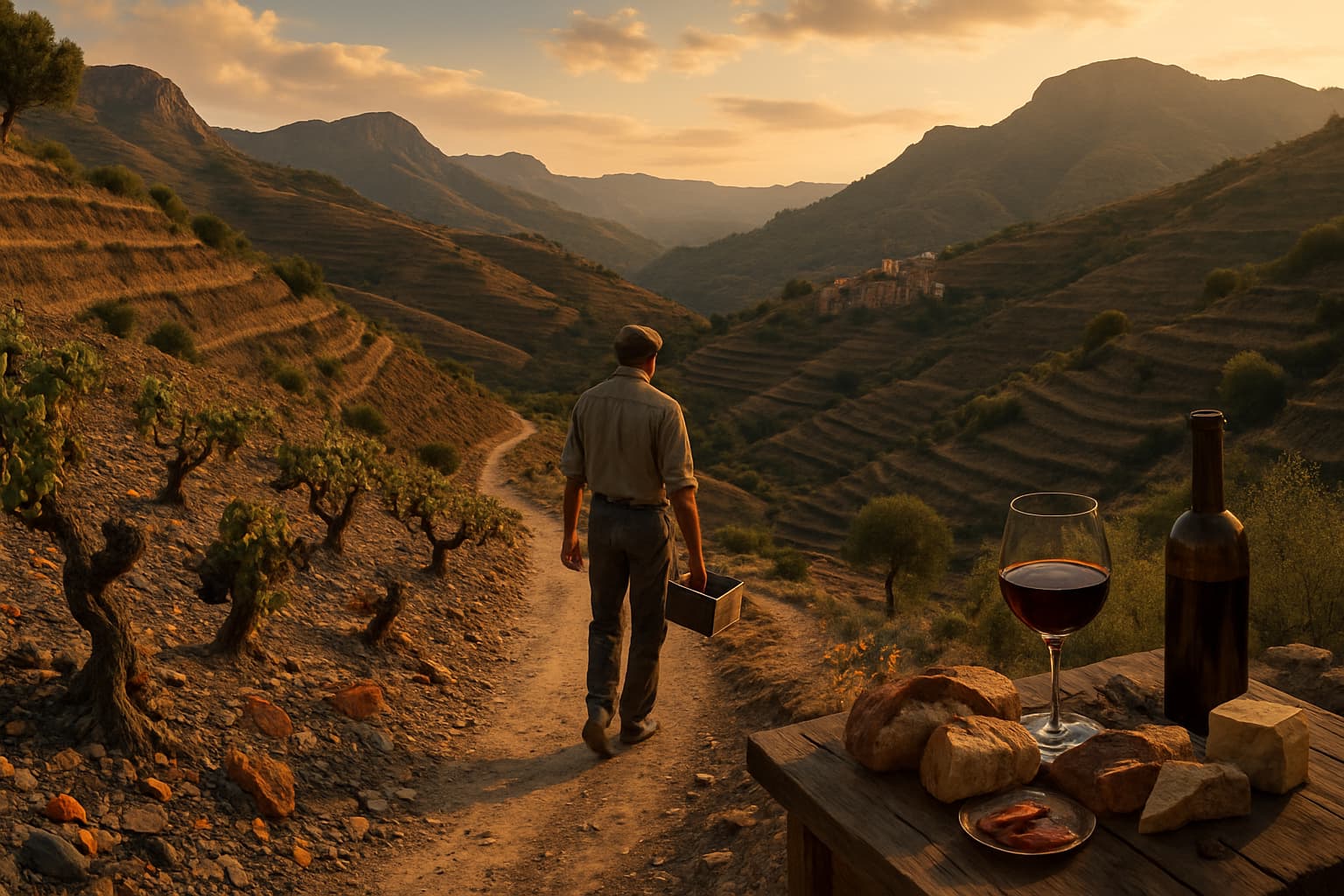
Long before wine was poured into crystal glasses and swirled for notes of blackberry and oak, it existed as something almost miraculous: wild yeast meeting wild grape, transforming sweet juice into something entirely new.
Archaeological evidence suggests that humans were making wine at least 8,000 years ago in the region we now call the South Caucasus — modern-day Georgia, Armenia, and parts of Iran. Clay vessels stained with ancient tartaric acid, the telltale fingerprint of wine, speak to a time when fermentation must have seemed like alchemy.
From these early experiments, winemaking spread along the great arteries of civilization: the Nile, the Mediterranean, the trade routes of the Phoenicians and Greeks. The Romans, with their roads and legions, carried vines across Europe, planting them in soils that would become legendary: Bordeaux’s gravel, Burgundy’s limestone, the slate of the Mosel.
Yet for all the march of empires, wine remained rooted in something humbler and more eternal: the vine itself, spiralling towards the sun, its roots searching in the dark for water and stone.
To appreciate wine is to appreciate terroir — a French term that describes the complete natural environment in which a wine is produced: the soil, the climate, the topography, and even the invisible life in and around the vineyard.
Imagine a hillside. On its upper slopes, the soil is thin and stony, draining water quickly and forcing the vines to struggle. Below, the earth is deeper, richer, more generous. The same grape variety planted in these two places will yield wines that speak in different accents.
Terroir is, in essence, the earth’s handwriting. Each wine is a letter written in that script, and to drink it attentively is to read the story of a place.
Within this grand theatre of soil and climate, a cast of characters takes the stage: the grape varieties themselves. Each has its own temperament, its own way of expressing the land.
These grapes are not mere ingredients; they are translators, converting sunlight, rainfall, and geology into flavour and aroma.
Once the grapes are harvested — often in the fragile hours of dawn, when the air is cool and the fruit firm — they begin a transformation.
At every step, human intention meets natural process. Winemaking is not the imposition of will upon nature, but a collaboration — an attempt to guide rather than control.
Across the globe, there are regions whose names have become synonymous with wine — places where climate, soil, and culture have converged over centuries.
Each region is a chapter in a global atlas, and together they form a map not only of geography, but of human adaptation to landscape.
Wine has woven itself into the fabric of human ritual. It marks celebrations and farewells, religious ceremonies and simple meals. To raise a glass is to acknowledge not only the present company, but a long lineage of those who have done the same.
With this culture has come a language — sometimes intimidating, often poetic. We speak of wines as “muscular” or “feminine,” of “nervy acidity” and “silky tannins,” of “forest floor,” “wet stone,” and “cigar box.” While such terms can seem fanciful, they reflect a genuine attempt to articulate something elusive: the way a wine feels, not just how it tastes.
At its best, wine language is not a barrier but a bridge — a way to share experience. And as our understanding grows, so does our humility. The more we taste, the more we realize how much remains unknown, how many vintages, vineyards, and bottles we will never encounter.
Around this ancient drink, an entire universe of literature and media has blossomed — a kind of ecosystem of ideas, opinions, and observations.
For centuries, scholars, merchants, and enthusiasts have written about wine: cataloguing vintages, praising regions, and attempting to classify what is, by nature, endlessly variable.
In more recent times, influential critics and writers have shaped public perception:
These works do more than inform; they humanize. They remind us that behind every bottle is a story of risk, labour, and love.
In the latter half of the 20th century, wine criticism took on a new form: the numerical score. A scale out of 100, or 20, attempted to capture, in a single figure, the quality of a wine.
These scores, published in influential magazines and newsletters, could make or break reputations and fortunes. A high rating might catapult a small producer to global fame; a poor one could consign a vintage to obscurity.
While such systems have helped many navigate a bewildering marketplace, they also raise philosophical questions. Can the complexity of a living, evolving wine truly be reduced to a number? Or does this miss something essential — the way a wine interacts with a particular moment, a particular meal, a particular mood?
Increasingly, readers turn not just to scores, but to voices they trust — critics whose palates and perspectives resonate with their own.
Today, the world of wine literature and media is more diverse than ever:
In this digital landscape, the authority of a single expert is replaced by a chorus of voices. Some are deeply knowledgeable; others are just beginning. Together, they create a rich, if sometimes cacophonous, tapestry.
To truly engage with wine is to become aware of time on multiple scales.
There is the immediate time of the glass in your hand: how the wine changes with each minute of air, how it warms slightly, how aromas unfurl like a flower opening at dawn.
There is the seasonal time of the vintage: a year of weather recorded in liquid form. A cool, wet summer; a hot, dry harvest; a sudden hailstorm — all are inscribed in the wine’s structure and flavour.
There is the geological time of the vineyard: soils formed over millions of years, ancient seabeds lifted to the surface, volcanic ash settled and compressed. When we speak of mineral notes in wine, we are, in a sense, tasting the memory of vanished oceans and long-extinct landscapes.
And finally, there is human time: generations of growers refining their craft, families tending the same vines decade after decade, traditions evolving in response to changing climates and markets. A bottle from a great-grandparent’s birth year can still be opened today, connecting past and present in a single, fragile moment.
Wine, then, is not just something we consume. It is something through which we can contemplate our place in the world — our dependence on soil and weather, our ingenuity, and our vulnerability.
When you next pour a glass of wine, pause for a moment. Hold it to the light and watch how it moves, how it clings to the sides of the glass. Inhale, and notice not just the obvious — the fruit, the oak — but the subtler notes: a hint of earth, a trace of stone, a suggestion of flowers or herbs.
In that glass lies a story: of a particular hillside, in a particular year, tended by particular hands. It is a story that has been shaped by countless forces — geological, climatic, cultural, and personal — and now, at last, it has reached you.
The world of wine is vast, and no single guide can capture all its intricacies. Yet this is part of its beauty. There will always be another region to discover, another grape to explore, another voice in the ever-growing body of wine literature and media to challenge and enrich your understanding.
To explore wine is to embark on a lifelong journey — one that rewards curiosity, patience, and humility. For in every bottle, there is not just flavour, but a quiet invitation: to slow down, to pay attention, and to listen, with all your senses, to the remarkable conversation between humanity and the living earth.
Tannins are astringent compounds found in wine that contribute to its texture and aging potential, often causing a drying or puckering sensation in the mouth. They are derived from grape skins, seeds, and stems, as well as from oak barrels used during aging.
/ˈtænɪnz/
Malic acid is a naturally occurring organic acid found in grapes that contributes to the tart, green apple-like flavor and crispness in wine. It plays a significant role in the taste and acidity of wine.
/mælɪk ˈæsɪd/
Harvest and Sorting
Grapes may be picked by hand or machine. In fine wine regions, teams move slowly along the rows, selecting only the ripest clusters. Back at the winery, sorting tables remove leaves, underripe berries, and any damaged fruit.
Crushing and Fermentation
The grapes are crushed, releasing their juice. For red wines, skins and juice ferment together, the skins imparting colour, tannin, and much of the wine’s texture. For whites, the juice is usually separated from the skins before fermentation.
Yeast — sometimes cultured, sometimes wild — consumes the grape sugars, producing alcohol and carbon dioxide. This is the moment when grape juice ceases to be fruit and becomes wine.
Maturation
Wine may rest in stainless steel, preserving freshness and purity, or in oak barrels, which can lend spice, structure, and subtle oxygenation. In dark, cool cellars, barrels lie like slumbering creatures, while within them, slow and quiet changes unfold.
Blending and Bottling
Many wines are blends — of grapes, of parcels, even of different barrels. The winemaker, like a composer, tastes and adjusts, balancing structure and aroma, power and elegance. Finally, the wine is bottled, sealed, and set aside, some to be drunk young, others to age and evolve.
France
Italy
Spain
Germany and Austria
Cool climates that coax Riesling and Grüner Veltliner into crystalline expressions of fruit and minerality, like mountain streams captured in glass.
The New World
Filtration in winemaking is the process of removing solid particles from wine to clarify and stabilize it before bottling, using various types of filters to achieve different levels of clarity and remove unwanted elements like yeast, bacteria, and sediment.
/fɪlˈtreɪʃən/
Oxidation in wine is a chemical reaction between the wine and oxygen that can change its flavor, aroma, and color. This process can be beneficial or detrimental depending on the extent and context of the exposure.
/ˌɒksɪˈdeɪʃən/
Microclimate refers to the unique climate conditions of a small, specific area within a larger region, significantly influencing grapevine growth and the characteristics of the resulting wine.
/ˈmīkrōˌklīmit/
Get weekly wine recommendations, vineyard news, and exclusive content delivered to your inbox.