Wine Tourism
“Where every bottle tells a story”
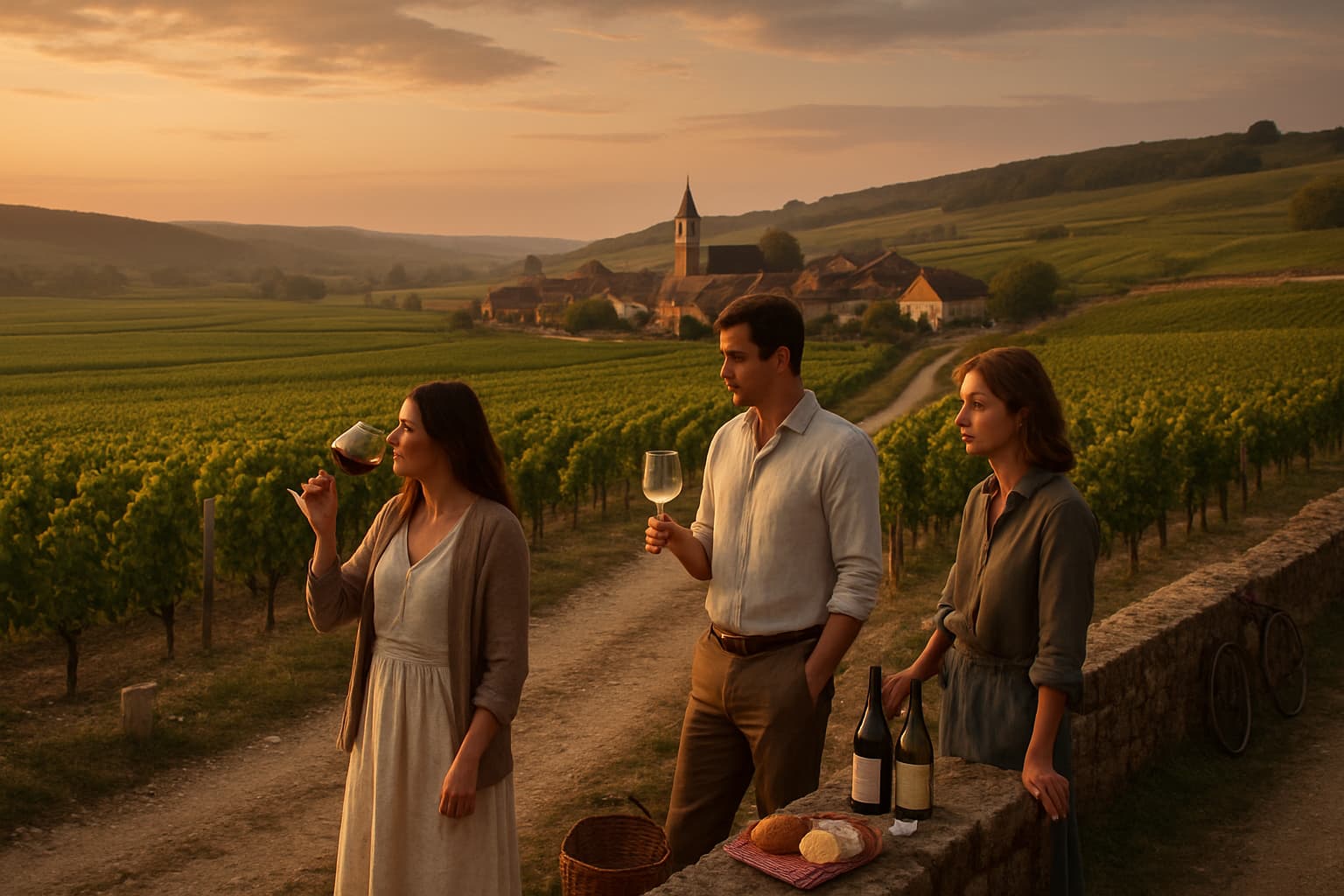
There are some journeys that feel less like travel and more like a slow, luxurious exhale. Burgundy is one of them. This is not a region you simply visit; it’s a place you sip, swirl, and surrender to. Imagine a landscape of gentle, undulating hills, ribboned with vines that have been tended for centuries, punctuated by golden-stoned villages where the church bells seem to ring on the hour just to remind you that time is passing—though you’d never know it from the languor of your own heartbeat.
Wine tourism in Burgundy is not about rushing from tasting to tasting with a checklist and a spittoon. It’s about giving yourself over to the rhythm of the vineyards, the play of light on limestone, the slow alchemy of grape into liquid silk. It’s an experience that unfolds on the tongue, in the nose, and somewhere deep in the chest where memory and pleasure conspire.
Let’s uncork it properly, shall we?
Before you step into your first cellar, it helps to know that Burgundy is not a single, monolithic wine region. It’s a patchwork quilt of tiny plots, each with its own personality, history, and, frankly, ego. Here, the concept of terroir—that almost mystical interplay of soil, climate, slope, and human touch—is not a romantic notion; it’s a religion.
Burgundy is essentially built on two grapes and a thousand nuances:
But to understand Burgundy as a wine tourist, you need to know its main subregions, each a different mood in the same love story:
This is the first seduction of Burgundy: the realization that a few meters up or down a slope, a shift in exposure, a whisper of limestone versus clay, can change the very character of what’s in your glass.
Burgundy’s vineyards are divided into climats—not “climate” as in weather, but distinct parcels of land, each named, delimited, and cherished. Think of them as characters in a sprawling family saga: some noble and aristocratic, others modest but quietly captivating.
You’ll see these names on labels and road signs: Les Amoureuses, Les Suchots, Les Perrières—poetry disguised as geography. As you drive or cycle through the vineyards, you’ll begin to notice stone walls, narrow tracks, and small markers indicating where one climat ends and another begins. It’s like crossing invisible borders between flavors.
For a wine tourist, this is more than technical detail. It’s a way of turning your visit into a kind of treasure hunt:
You’ll feel, sip by sip, how the land itself is speaking. Burgundy is not a region that shouts; it murmurs. You lean in closer, and the whisper becomes addictive.
Most wine journeys in Burgundy orbit around Beaune, and with good reason. This small, honey-stoned town is both a working wine hub and a gastronomic playground. It’s a place where barrels are rolled through cobbled streets and wine shops glow like jewel boxes.
A few indulgent highlights:
Hospices de Beaune (Hôtel-Dieu): A medieval hospital with a dazzling, multi-colored tiled roof. Beneath its history of charity lies a serious wine legacy: the Hospices owns vineyards across Burgundy and hosts one of the world’s most famous wine auctions each November. Even if you don’t attend the auction, walking through its quiet courtyards, then tasting wines from Hospices-labeled bottles in town, feels like sipping history.
: Many (wine merchants) offer tours of their labyrinthine cellars—cool, dim, and lined with slumbering bottles. Descending into these spaces is like stepping into a secret world where time is measured in vintages, not minutes.
Beaune is the sort of town where you find yourself strolling out after dinner just to inhale the night air and listen to the faint clink of glasses behind shuttered windows. It feels conspiratorial, deliciously so.
From Beaune, the Côte d’Or—literally “Golden Slope”—stretches north and south in a narrow band of vineyard-draped hills. This is where wine tourism in Burgundy becomes a sensual pilgrimage.
To the north lies the Côte de Nuits, home to some of the most coveted red wines on earth. Villages such as Gevrey-Chambertin, Morey-Saint-Denis, Chambolle-Musigny, Vosne-Romanée, and Nuits-Saint-Georges line the route like a string of pearls.
Here, the wines are often:
As a visitor, you might:
There is something almost disarming about standing beside a Grand Cru vineyard, looking at rows of vines that, in bottled form, can command staggering prices, while the soil under your shoes is just… earth. It’s humbling and thrilling at once.
South of Beaune, the Côte de Beaune offers both luminous whites and seductive reds. Names like Meursault, Puligny-Montrachet, Chassagne-Montrachet, Pommard, and Volnay beckon like characters in a novel you’re dying to read.
Here, wine tourism is a dance between cellar and table. You might:
While the Côte d’Or may be Burgundy’s most glamorous child, its siblings are every bit as charming—and often kinder to your wallet.
Far to the north, Chablis is a world of its own. The vineyards sit on ancient Kimmeridgian limestone, and the wines reflect this: cool, precise, mineral, often with a hint of oyster shell.
As a wine tourist, Chablis offers:
To the south, the Côte Chalonnaise and Mâconnais offer a softer, more rural rhythm. Villages like Mercurey, Givry, Rully, and Mâcon produce wines that are often more approachable young and more forgiving on the budget.
Here you might:
This is Burgundy without the crowds, but with all the heart.
Wine tourism in Burgundy is not about how many domaines you can check off in a day. It’s about how deeply you can sink into each experience. A few indulgent guidelines:
Above all, let each glass be a conversation, not a conquest.
You cannot talk about wine tourism in Burgundy without talking about food. They’re lovers, these two, inseparable and mutually enhancing.
Expect to encounter:
In Burgundy, meals are not interruptions to your wine exploration; they are its climax and continuation.
Pleasure may be the guiding principle, but a little planning makes it all the more luxurious:
Pack curiosity, a notebook if you’re inclined to remember every sip, and clothes that allow for generous meals.
At some point—though you may try to deny it—you will have to leave. You’ll pack a few bottles, perhaps more than a few, wrapping them in clothes and crossing your fingers at the check-in desk. But what you really take home from wine tourism in Burgundy can’t be boxed or insured.
You carry with you:
Burgundy, in the end, is not about ticking off famous names or boasting of Grand Crus tasted. It’s about allowing yourself to be seduced, slowly and thoroughly, by a landscape where pleasure is not rushed, but ripened.
You go for the wine, yes. But you return, in memory and in longing, for the way Burgundy makes you feel: attuned, alive, and just a little bit intoxicated by the sheer, sensual joy of being there.
Tannins are astringent compounds found in wine that contribute to its texture and aging potential, often causing a drying or puckering sensation in the mouth. They are derived from grape skins, seeds, and stems, as well as from oak barrels used during aging.
/ˈtænɪnz/
Malic acid is a naturally occurring organic acid found in grapes that contributes to the tart, green apple-like flavor and crispness in wine. It plays a significant role in the taste and acidity of wine.
/mælɪk ˈæsɪd/
Wine shops and bars: Beaune is full of cavistes and wine bars where you can taste flights of wines by the glass. This is your chance to compare different villages or climats without committing to full bottles—think of it as speed dating, Burgundy-style.
Filtration in winemaking is the process of removing solid particles from wine to clarify and stabilize it before bottling, using various types of filters to achieve different levels of clarity and remove unwanted elements like yeast, bacteria, and sediment.
/fɪlˈtreɪʃən/
Oxidation in wine is a chemical reaction between the wine and oxygen that can change its flavor, aroma, and color. This process can be beneficial or detrimental depending on the extent and context of the exposure.
/ˌɒksɪˈdeɪʃən/
Microclimate refers to the unique climate conditions of a small, specific area within a larger region, significantly influencing grapevine growth and the characteristics of the resulting wine.
/ˈmīkrōˌklīmit/
Get weekly wine recommendations, vineyard news, and exclusive content delivered to your inbox.