Wine Tourism
“Where every bottle tells a story”
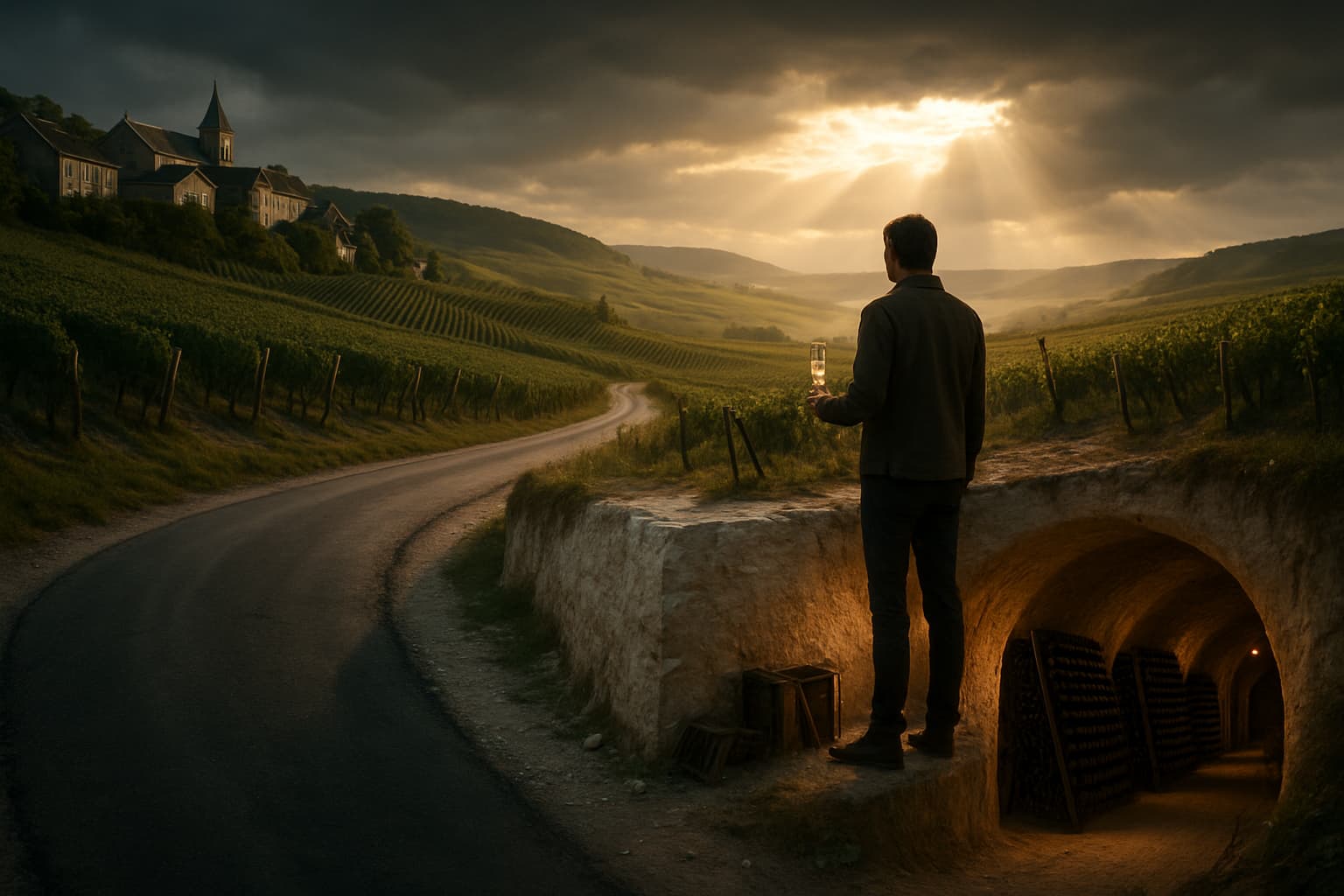
The road into Champagne always feels like a bad idea at first. Too clean, too civilized, like a postcard cooked up by a tourism board having a nervous breakdown. But then the hills start to roll, the chalk rises under your wheels like some ancient white beast, and you realize this isn’t wine country—it’s controlled madness in a bottle, a landscape built on pressure, patience, and the constant threat of explosion.
You don’t come here for “wine.” You come to drink bottled shrapnel from the French psyche, fermented in the dark and sold as celebration. Champagne is a weapon disguised as luxury. And wine tourism here—if you do it right—is less a vacation and more a pilgrimage to the altar of bubbles and excess.
Let the bus tours have their sanitized flute-sipping. We’re going underground.
The first thing you need to understand is that Champagne is not just a drink; it’s a place that barely makes sense on paper. Northeastern France. Too cold, too marginal. A region that had no business becoming the world capital of liquid hedonism.
Three main zones of madness:
Underneath all of it: chalk. Fossilized marine skeletons from some ancient sea that had no idea it would one day be enlisted into French marketing mythology. This chalk is the secret—draining water, reflecting light, and acting like a giant thermal battery. It’s also carved out into miles of crayères—cathedral-like cellars where millions of bottles wait in the dark like sleeping grenades.
Reims is your logical entry point, which makes it inherently suspicious. High-speed train from Paris, big houses, big money. But if you’re going to understand Champagne, you have to start with the monsters.
You’ll see the names before you taste them: Veuve Clicquot, Taittinger, Pommery, Ruinart, Mumm. These are not wineries; they are industrial-scale shrines to consistency and marketing, with budgets that could finance a small coup.
What you get from visiting:
The tastings here are polished and controlled. You’ll get the Brut NV, maybe a vintage, maybe a prestige cuvée if you pay or look sufficiently obsessed. It’s all very civilized, which is disorienting given that the stuff in the glass could take your eye out if the glass fails.
Tourism tip from the edge: Book at least one of these “house of worship” visits. You need to see the industrial scale to understand what Champagne has become: a global luxury engine powered by tiny bubbles and massive logistics.
If Reims is the capital, Épernay is the boardroom—smaller, but every cobblestone is soaked in money and ego. The Avenue de Champagne is a straight shot of wealth, lined with houses like Moët & Chandon, Perrier-Jouët, Pol Roger. Under your feet: more than 100 kilometers of cellars. Above: mansions. Below: bottles.
You can walk the whole thing in under an hour, but that would be a crime. This is where you slow down, schedule tastings, and watch how each house tries to convince you they alone have the key to the kingdom.
You’ll notice:
Moët & Chandon is the behemoth—oceans of wine, polished tours, the spiritual home of Dom Pérignon the brand (not the monk). Pol Roger feels more old-school, Churchill’s favorite, with a more buttoned-up, classic English-leaning style. Perrier-Jouët throws flowers on the bottle and seduces with Art Nouveau.
If you have a liver and a schedule: Two houses on the Avenue in one day is plenty. Any more and you’ll start confusing phenolic bitterness with existential dread.
The real madness—the good kind—lives outside the big gates. You see it when you leave the main towns and dive into the villages: Ay, Avenay-Val-d’Or, Bouzy, Ambonnay, Avize, Le Mesnil-sur-Oger, Cramant. Names that sound like spells and drink like confessions.
For decades, the game was rigged: growers sold grapes to the big houses, who blended everything into brand consistency. Then the growers started bottling their own wine. Now you have RM (Récoltant-Manipulant) Champagne—grower-producer bottles—labeled with their own names, their own parcels, their own neuroses.
This is where things get interesting:
Names to look for (if you care about the frontier): Selosse, Agrapart, Vilmart, Bérêche, Egly-Ouriet, Larmandier-Bernier, Pierre Peters, and a hundred more. You won’t always get polished tours. Sometimes it’s the vigneron’s kid pouring in a cramped tasting room that doubles as an office. But the wines will tell you more truth in one glass than a PR department can in a decade.
Survival tactic: Book in advance. These are working farms, not theme parks. Show up unannounced and you might find a closed gate and a tractor instead of a tasting.
Champagne is a region obsessed with time. Every bottle is a negotiation with it.
To be called Champagne, the wine has to be:
In the cellars, time moves differently. Bottles lie on their sides in the half-dark, bathed in silence and the faint scent of yeast and damp stone. Riddling racks hold bottles at angles like frozen dancers mid-collapse. In the old days, everything was done by hand, a riddler twisting thousands of bottles a day. Now it’s mostly gyropalettes, robot cages calmly spinning wine while the romance is outsourced to the tour script.
The whole system is about pressure—literal and metaphorical. Around 6 atmospheres in each bottle. More than a car tire. Enough to turn glass into shrapnel if something goes wrong. But if everything goes right, you get that surreal moment when the cork pops, the mousse rises, and the chaos is suddenly civilized in your glass.
Forget the tasting-room vocabulary pageantry. You don’t need to talk about “crushed river stones” unless you’re actively chewing gravel.
What matters in Champagne:
Taste side by side:
You’ll start to feel the region’s schizophrenia: luxury vs agriculture, precision vs chaos, brand vs vineyard.
This is not Disneyland. It’s an active agricultural war zone dressed up in fine glassware.
Underneath the tourism brochures and the “romance of the bubbles,” there’s something else. Champagne is a region built on contradiction: a cold, harsh climate turned into a symbol of celebration; a farming culture wrapped in a luxury narrative; a drink born from technical error turned into the global standard for success.
Wine tourism here, if you let it, becomes a study in how humans handle pressure:
You come out of the cellars, pupils contracting in the sunlight, glass in hand, and the whole thing hits you: this is not just a beverage. It’s a controlled detonation of history, geology, economics, and human obsession, disguised as refreshment.
If you do Champagne right, you don’t just leave with bottles. You leave with a new respect for what it takes to turn marginal land and brutal climate into something people use to christen ships and toast weddings. You leave understanding that beneath the gold foil and etched glass, it’s still farming. Still risk. Still madness.
And the next time you hear that cork pop, you won’t just think “celebration.” You’ll think of chalk under your feet, cold tunnels full of sleeping pressure, and a region that bet everything on bubbles—and won.
Then you’ll raise your glass, feel the sting of the acid, the prickle of the mousse, and you’ll know: this isn’t just tourism. It’s pilgrimage by the bottle, and the gods you’re visiting are made of yeast, time, and nerve.
Tannins are astringent compounds found in wine that contribute to its texture and aging potential, often causing a drying or puckering sensation in the mouth. They are derived from grape skins, seeds, and stems, as well as from oak barrels used during aging.
/ˈtænɪnz/
Malic acid is a naturally occurring organic acid found in grapes that contributes to the tart, green apple-like flavor and crispness in wine. It plays a significant role in the taste and acidity of wine.
/mælɪk ˈæsɪd/
Filtration in winemaking is the process of removing solid particles from wine to clarify and stabilize it before bottling, using various types of filters to achieve different levels of clarity and remove unwanted elements like yeast, bacteria, and sediment.
/fɪlˈtreɪʃən/
Oxidation in wine is a chemical reaction between the wine and oxygen that can change its flavor, aroma, and color. This process can be beneficial or detrimental depending on the extent and context of the exposure.
/ˌɒksɪˈdeɪʃən/
Microclimate refers to the unique climate conditions of a small, specific area within a larger region, significantly influencing grapevine growth and the characteristics of the resulting wine.
/ˈmīkrōˌklīmit/
Get weekly wine recommendations, vineyard news, and exclusive content delivered to your inbox.