
Wine Tourism
“Where every bottle tells a story”
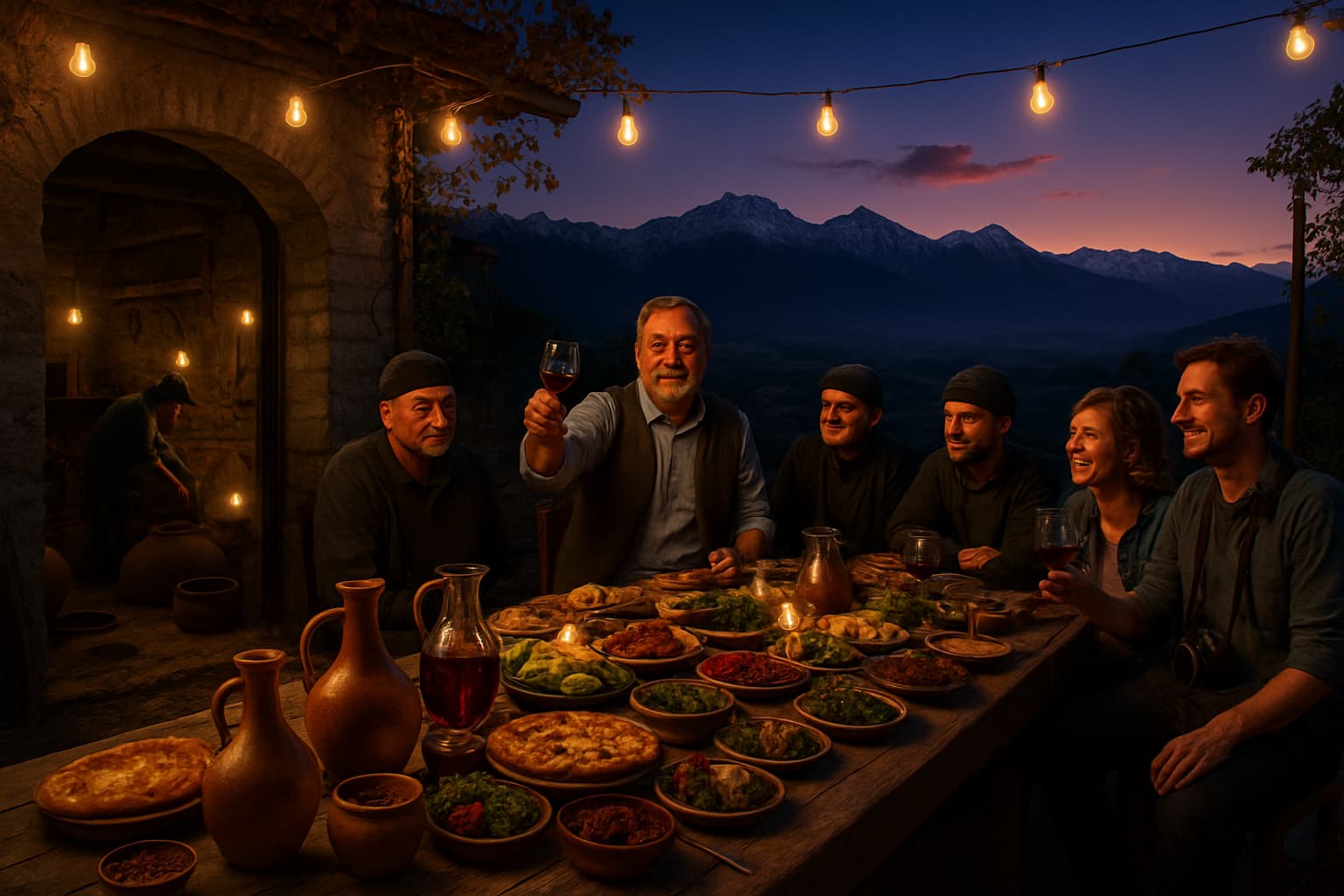
There are places you drink wine, and there are places wine drinks you. Georgia is the second kind.
Not the Georgia with Waffle House and SEC football—no, the other one, wedged between the Caucasus Mountains and the Black Sea, where people have been fermenting grapes since before they had the decency to invent written language or hangovers. You don’t just visit this Georgia for “wine tasting.” You submit yourself to an 8,000-year-old, civilization-wide experiment in controlled intoxication and radical hospitality, and hope you come out the other side with your liver and your sanity mostly intact.
This is wine tourism in Georgia: not a hobby, not a weekend diversion, but a full-contact, multi-day immersion into a culture that believes God Himself enjoyed a glass and probably left His sandals somewhere in Kakheti after a supra that went on three days too long.
Buckle up. The road is winding, the drivers are insane, and the wine is older than your religion.
Archaeologists in their dusty little trenches will tell you this is the “cradle of wine.” Clay fragments with tartaric acid residue, grape pips from 6,000 BCE—evidence of fermentation long before France was anything but a damp forest full of confused Celts.
Georgians don’t need the lab reports. They’ll tell you they’ve always made wine. It’s not a trend, it’s not a “heritage brand,” it’s just what you do if you’re born between these mountains and this sea. You plant vines, you bury clay vessels in the ground, you argue with your neighbors about which grape is king, and you drink like the Mongols are coming back tomorrow.
Wine is not a side dish here. It’s the bloodstream of the culture. Every family, from the taxi driver in Tbilisi to the retired engineer in Telavi, either has a vineyard, had a vineyard, or is actively complaining that they should have a vineyard.
If you come to Georgia for wine, understand: you’re not a customer. You’re a target—a willing victim of a nationwide plot to fill you with fermented grape juice and homemade chacha until you start to understand the language of the mountains.
Forget your stainless steel tanks and French oak barrels with the price tags of German sedans. Georgia’s wine soul lives underground in massive clay vessels called qvevri—egg-shaped, beeswax-lined amphorae buried up to their necks in the earth like ancient terracotta submarines.
This is not some hipster innovation. This is the original operating system of winemaking. Grapes—skins, stems, seeds, sometimes even the whole damn cluster—go into the qvevri, get sealed up, and are left to ferment with the calm, patient indifference of geology itself. Months pass. The earth regulates the temperature. Gravity does its work. The chaos of life and death in the grape skins resolves into something coherent, dangerous, and very much alive.
UNESCO, in a rare moment of sanity, recognized this as intangible cultural heritage. But it’s more than that. It’s a philosophy:
You stand in a marani (traditional wine cellar), the air cool and damp, and look down at these wide-mouthed clay wells in the stone floor. Somewhere below your feet, millions of microscopic yeasts are throwing an invisible riot, turning sugar into alcohol and chaos into something you can pour into a glass and blame for your decisions.
In Georgia, you don’t just taste qvevri wine. You crawl into the same timeline as people who were drinking out of similar vessels when the pyramids were still a wild idea.
If Georgia is the cradle of wine, Kakheti is the loaded bottle someone left in that cradle and forgot to take away. This is the country’s main wine region, an endless patchwork of vineyards stretching toward the snowy fangs of the Caucasus, with villages that sound like incantations: Telavi, Sighnaghi, Kvareli, Tsinandali.
Telavi is your likely base camp—a sleepy little town that pretends to be modest while surrounded by some of the most important vineyards in the country. From here, you can spin in any direction and hit:
You’ll taste Saperavi, that ink-dark red that laughs at your attempts to rinse it from your teeth. You’ll meet Rkatsiteli, the white grape that’s been around since people thought bronze was cutting-edge tech. And you’ll start to understand that “amber wine” here isn’t a trend—it’s a way of life.
Perched on a hillside with a view of the Alazani Valley that looks like a postcard someone slipped you during a nervous breakdown, Sighnaghi is the prettified face of Kakheti: cobbled streets, pastel facades, and enough guesthouses to absorb a small invading army.
This is where you come when you want to pretend you’re in some alternate-universe Tuscany where the food is better, the wine is cheaper, and the locals are far more determined to get you drunk. It’s also where you start to understand supra, the Georgian feast, which is less a meal and more a controlled demolition of your self-control.
To do wine tourism in Georgia without surviving at least one supra is like going to Pamplona and skipping the bulls. This is the central ceremony of Georgian life: the long table, the impossible avalanche of dishes, the toasts that stretch into the night like some kind of verbal marathon.
At the head of the table sits the tamada—the toastmaster, priest, and emotional stuntman of the evening. His job is nothing less than to drag every soul at that table through the full spectrum of human existence using nothing but wine and words.
The toasts come in waves:
Each toast is not a quick clink and sip. It’s a speech, a story, a confession—sometimes a therapy session with two liters of Saperavi riding shotgun. You drink at the end of each one, and the wine keeps coming: pitchers, carafes, old plastic bottles refilled from the qvevri out back.
By the third hour, you’re not just a tourist. You’re implicated. You’ve been woven into their narrative. Your name has been spoken in toasts about friendship and fate. You are now, in some small, dangerous way, part of this place.
Eventually, you stagger back to Tbilisi, the capital, which is what happens when you let a medieval town grow up under the psychological pressure of empires, invasions, and cheap electricity.
Here, wine has gone metropolitan:
You’ll hear words like “natural,” “low-intervention,” and “orange wine” thrown around with religious fervor. The irony is that Georgians have been making “natural wine” since before anyone had to differentiate it from the industrial kind. For them it’s not a movement; it’s Tuesday.
If you’ve still got functioning brain cells and a stomach lining, the rest of Georgia opens up like a map someone spilled wine on.
Every region has its grapes, its microclimates, its obsessions. You could spend a month here and barely scratch the surface. You could spend a year and still be surprised by a backyard marani in some anonymous village where a guy in rubber boots pours you the best wine you’ll drink all week out of a reused Coca-Cola bottle.
You’re not coming here for a spa cleanse. But you can tilt the odds in your favor.
You land in Georgia thinking you’re here to taste wine. You leave realizing wine was just the bait. The real thing they’ve been pouring into you is something older and stranger:
The bottles you haul home will eventually empty. The labels will fade, the corks will dry out, and you’ll forget which vintage came from which village. What stays is the memory of that night in a stone cellar in Kakheti, or that cramped apartment in Tbilisi, when someone raised a glass and included you in a toast about friendship, or fate, or the bizarre fact that people from such distant worlds could end up at the same table.
Wine tourism in Georgia is not about collecting experiences like stamps. It’s about letting a place this old and this stubborn get under your skin, stain your teeth, scramble your calendar, and rearrange your sense of what travel—and drinking—are actually for.
You don’t come here to stay in control. You come here to surrender, one clay-cupped, amber-glowing glass at a time.
Tannins are astringent compounds found in wine that contribute to its texture and aging potential, often causing a drying or puckering sensation in the mouth. They are derived from grape skins, seeds, and stems, as well as from oak barrels used during aging.
/ˈtænɪnz/
Malic acid is a naturally occurring organic acid found in grapes that contributes to the tart, green apple-like flavor and crispness in wine. It plays a significant role in the taste and acidity of wine.
/mælɪk ˈæsɪd/
Filtration in winemaking is the process of removing solid particles from wine to clarify and stabilize it before bottling, using various types of filters to achieve different levels of clarity and remove unwanted elements like yeast, bacteria, and sediment.
/fɪlˈtreɪʃən/
Oxidation in wine is a chemical reaction between the wine and oxygen that can change its flavor, aroma, and color. This process can be beneficial or detrimental depending on the extent and context of the exposure.
/ˌɒksɪˈdeɪʃən/
Microclimate refers to the unique climate conditions of a small, specific area within a larger region, significantly influencing grapevine growth and the characteristics of the resulting wine.
/ˈmīkrōˌklīmit/
Get weekly wine recommendations, vineyard news, and exclusive content delivered to your inbox.