Wine Tourism
“Where every bottle tells a story”
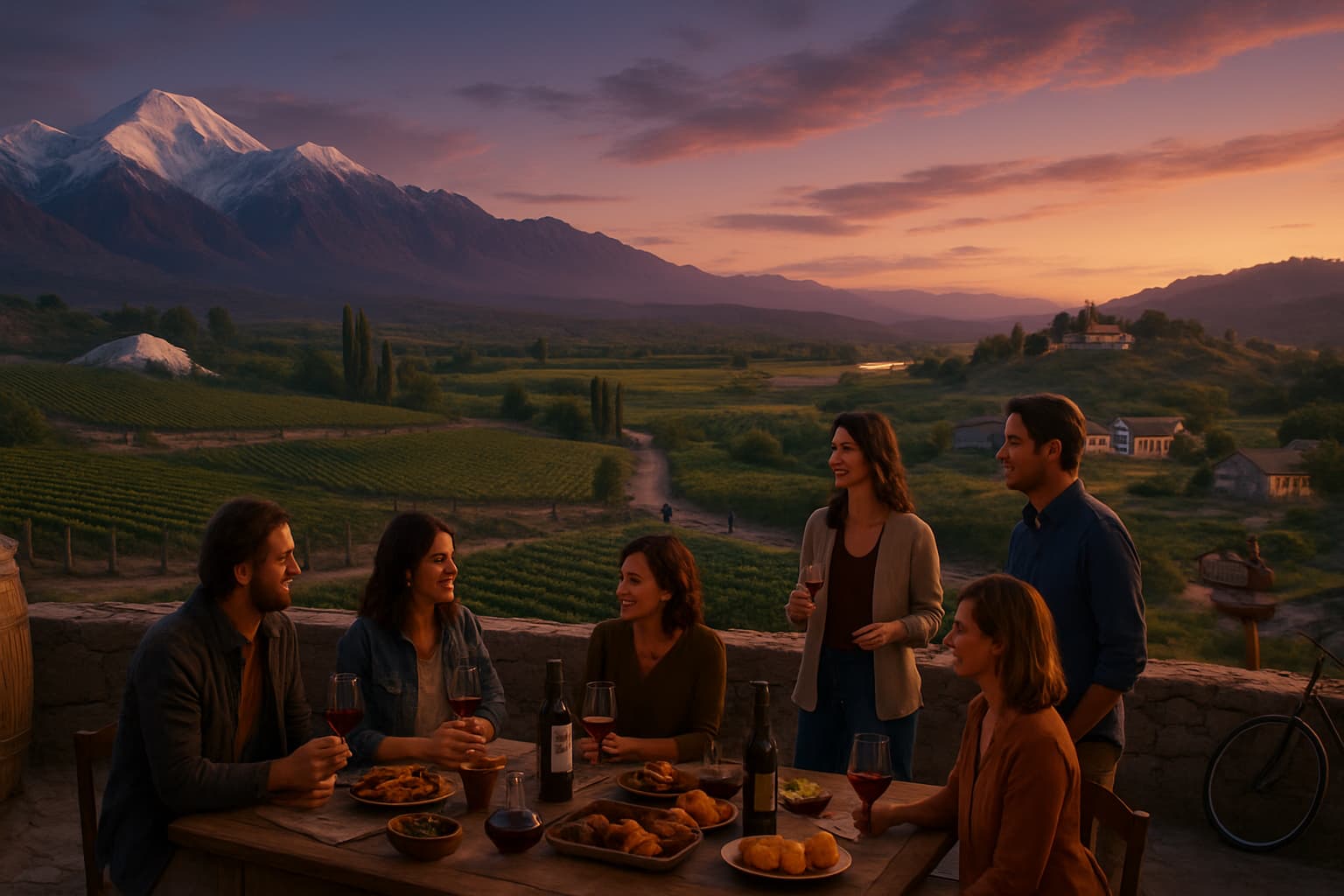
It is a truth very generally acknowledged that a gentleman or lady in possession of a curious palate must, sooner or later, feel a desire to travel. If, in addition, that palate is inclined towards the vine, and the traveller entertains even the slightest romantic disposition, then South America—vast, various, and vinous—presents itself as a suitor difficult to refuse.
To roam among its vineyards is not merely to taste wine, but to encounter landscapes of almost theatrical extravagance, histories of conquest and resilience, and societies still learning to reconcile Old World traditions with New World boldness. The continent offers not a single orderly promenade, but a series of grand adventures, from snow‑capped Andes to Atlantic shores, each region vying for the visitor’s attention like a debutante at her first ball.
What follows is an examination, as impartial as affection will allow, of the principal wine regions of South America, the character of their wines, and the peculiar pleasures they afford the travelling oenophile.
To understand why South America has become a favourite object of wine tourism, one must first consider its particular felicities. The continent combines:
For the traveller accustomed to the polished formality of Bordeaux or the dignified reserve of Burgundy, South America may at first appear a little too free in its manners. Yet beneath this vivacity lies a growing seriousness about terroir, sustainability, and craftsmanship. One comes for the adventure; one remains for the wine.
If South American wine regions were characters at a country assembly, Argentina would be the tall, dark stranger in the corner—Mendoza’s Malbec in hand, mountains at his back, and a history of both misfortune and remarkable recovery.
Mendoza is the undisputed star of Argentine wine, a high‑desert oasis at the foot of the Andes. Here, vineyards sit at elevations often between 900 and 1,500 metres, bathed in abundant sunshine and cooled by mountain nights.
For the wine traveller, Mendoza offers:
The subregions—Luján de Cuyo, Maipú, and the higher‑altitude Uco Valley—permit the traveller to observe how a single grape can alter its character with changes in elevation and soil, much as a gentleman’s manners may improve or deteriorate according to the company he keeps.
Though Malbec is the principal object of admiration, it would be unjust to ignore Argentina’s other charms. Cabernet Sauvignon, Bonarda, and increasingly elegant Chardonnays and Torrontés (particularly from the high, arid region of Salta) reveal a country eager to be known for more than one accomplishment.
Wine routes are well established, with cycling tours, boutique lodges among the vines, and architectural showpieces of wineries that seem designed as much for admiration as for production. One may pass from rustic, family‑run bodegas to sleek, glass‑and‑concrete temples of modern oenology in a single afternoon—much like travelling from a modest parsonage to the grandest estate in the county.
If Argentina is the brooding romantic, Chile is the composed, well‑ordered neighbour—stretched like a ribbon between mountains and sea, apparently designed by geography for viticulture and by temperament for steady improvement.
The Maipo, Colchagua, and Cachapoal valleys form the beating heart of Chilean wine production. Here the visitor will find:
Wine tourism in these valleys is well established: charming hacienda‑style lodgings, horseback rides among the vines, and pairings of wine with Chile’s hearty cuisine—empanadas, grilled meats, and seafood from the nearby Pacific.
In recent years, Chile has displayed a positively enterprising spirit, sending vines towards the cool Pacific and up into the hills. The Casablanca and San Antonio valleys near the coast produce crisp Sauvignon Blanc and elegant Chardonnay, their freshness owing much to ocean breezes and morning fogs.
Farther south, regions such as Itata and Bío‑Bío are being rediscovered, their old bush vines of País and Cinsault suddenly treated not as relics but as treasures. The traveller who ventures here may feel a little like a heroine discovering that the quiet, overlooked gentleman in the corner is, in fact, possessed of the most interesting conversation.
Uruguay, smaller and less theatrically endowed in landscape than its neighbours, has about it the air of a well‑read cousin—unassuming in manner, yet capable of surprising depth. Its principal grape, Tannat, was imported from the French Basque country and has taken to Uruguayan soils with a stubborn determination that commands respect.
Uruguayan vineyards, many of them near the Atlantic coast or along the Río de la Plata, benefit from cooling maritime breezes. Tannat, notorious elsewhere for its severity of tannin, here becomes more civilised: still firm, but with a generosity of dark fruit and, in the hands of a considerate winemaker, a structure that promises graceful ageing rather than immediate reprimand.
For the wine traveller, Uruguay offers:
The country’s wine tourism is less ostentatious than that of Argentina or Chile, but therein lies its charm: intimacy, authenticity, and the feeling that one has discovered something not yet entirely overrun by fashion.
To speak of South American wine and omit Brazil would be as unpardonable as neglecting to introduce a promising young lady at a dance. Though more famed for its beaches and carnival, Brazil has developed a serious and increasingly confident wine culture, particularly in the southern region of Serra Gaúcha.
The cooler, higher‑altitude vineyards of southern Brazil have shown a particular talent for sparkling wines, produced by both the traditional and Charmat methods. These wines, lively and refreshing, reflect a national character that seems constitutionally opposed to gloom.
Wine routes around towns such as Bento Gonçalves offer:
Other South American countries—Peru, Bolivia, even Paraguay—are nurturing vineyards in high valleys and unexpected corners. These regions are, in touristic terms, still in their early chapters, but for the traveller of adventurous spirit, they offer the satisfaction of encountering wines and stories before they become the topic of every drawing‑room conversation.
No amount of romantic enthusiasm should entirely supplant prudence. A few considerations will ensure that one’s South American wine tour remains a delight rather than a cautionary tale.
Perhaps the most engaging aspect of wine tourism in South America is the sensation of observing a character still in the process of forming itself. In Europe, many regions have had centuries to polish their reputations, like old silver brought out for every family occasion. South America, by contrast, is in the flush of self‑discovery.
Winemakers debate organic and biodynamic methods, experiment with amphorae and concrete eggs, and revive nearly forgotten varieties with missionary zeal. Women are increasingly present in leadership roles; younger generations return from studies abroad determined to express their own landscapes rather than imitate those of others.
For the traveller, this means that each visit is not merely a lesson in what has been, but a glimpse of what might yet be. One tastes not only the wine in the glass, but the region’s aspirations—its desire to be taken seriously, its pride in its land, its impatience with old prejudices that dismissed New World wines as brash and unschooled.
To travel through South America’s vineyards is to encounter a continent negotiating its relationship with tradition, modernity, and the natural world. The vines, many of them descended from cuttings carried by missionaries and settlers centuries ago, now root themselves in identities that are distinctly Argentine, Chilean, Uruguayan, Brazilian, and beyond.
The visitor is invited not merely to sip and depart, but to linger—to observe how climate, soil, culture, and history mingle in the glass; to appreciate the dignity of small, family‑run estates alongside the impressive efficiency of larger operations; to recognise that excellence may be found in both polished tasting rooms and humble barrel cellars.
Wine tourism in South America, then, is more than a succession of agreeable intoxications. It is an education in landscape and character, in resilience and reinvention. One arrives, perhaps, in search of Malbec or Carmenère; one leaves with a richer understanding of a continent that has taken the venerable art of winemaking and made it, unmistakably, its own.
And if, upon returning home, one finds that every glass of South American wine recalls a sunset over the Andes, a conversation in a vineyard courtyard, or the distant sound of waves beyond a row of vines—well, such are the inevitable consequences of too much enjoyment. No prudent person would recommend against it.
Tannins are astringent compounds found in wine that contribute to its texture and aging potential, often causing a drying or puckering sensation in the mouth. They are derived from grape skins, seeds, and stems, as well as from oak barrels used during aging.
/ˈtænɪnz/
Malic acid is a naturally occurring organic acid found in grapes that contributes to the tart, green apple-like flavor and crispness in wine. It plays a significant role in the taste and acidity of wine.
/mælɪk ˈæsɪd/
Filtration in winemaking is the process of removing solid particles from wine to clarify and stabilize it before bottling, using various types of filters to achieve different levels of clarity and remove unwanted elements like yeast, bacteria, and sediment.
/fɪlˈtreɪʃən/
Oxidation in wine is a chemical reaction between the wine and oxygen that can change its flavor, aroma, and color. This process can be beneficial or detrimental depending on the extent and context of the exposure.
/ˌɒksɪˈdeɪʃən/
Microclimate refers to the unique climate conditions of a small, specific area within a larger region, significantly influencing grapevine growth and the characteristics of the resulting wine.
/ˈmīkrōˌklīmit/
Get weekly wine recommendations, vineyard news, and exclusive content delivered to your inbox.