Wine Tourism
“Where every bottle tells a story”
There are places on this earth where time does not simply pass. It lingers. It settles into the soil, into stone, into the hands of people who have been doing the same sacred work for longer than memory can hold. Kakheti, in eastern Georgia, is one of those places.
If you listen closely, in the hush between vineyard rows and the quiet of cool clay cellars, you can almost hear it: the slow heartbeat of 8,000 years of winemaking. They call Georgia the “cradle of wine,” and nowhere does that feel more true than in Kakheti, where wine is not just a drink, but a language, a faith, and a way of seeing the world.
This is not a story of polished tasting rooms and hurried tours. This is a story of earth and clay, of families and feasts, of a people who never stopped believing that wine is one of the ways human beings make sense of being alive.
Drive east from Tbilisi, and the landscape begins to open like a great old book. Hills soften into wide valleys, the air thins and sharpens, and ahead of you, the Caucasus Mountains rise like a wall of stone and snow.
This is Kakheti.
To your left and right, vineyards stretch across the Alazani and Iori valleys, row after row of vines that have seen empires rise and fall. Villages huddle around church towers and old stone walls. Rustaveli Avenue and city lights feel a world away.
Wine tourism in Kakheti is not just about tasting wine; it’s about stepping into a living landscape where every hill has a story, every family a tradition, and every glass a memory of the land that made it.
Long before France spoke the language of Bordeaux, before Italy whispered of Chianti, people in this corner of the Caucasus were already crushing grapes and burying their hopes in the ground.
Archaeologists have found wine residues in clay vessels from Georgia dating back over 8,000 years. Tiny crystals of tartaric acid, grape pollen, and seeds—silent testimonies that this land was cultivating and fermenting grapes when much of the world was still learning to till the soil.
The method they used then is still alive now: qvevri.
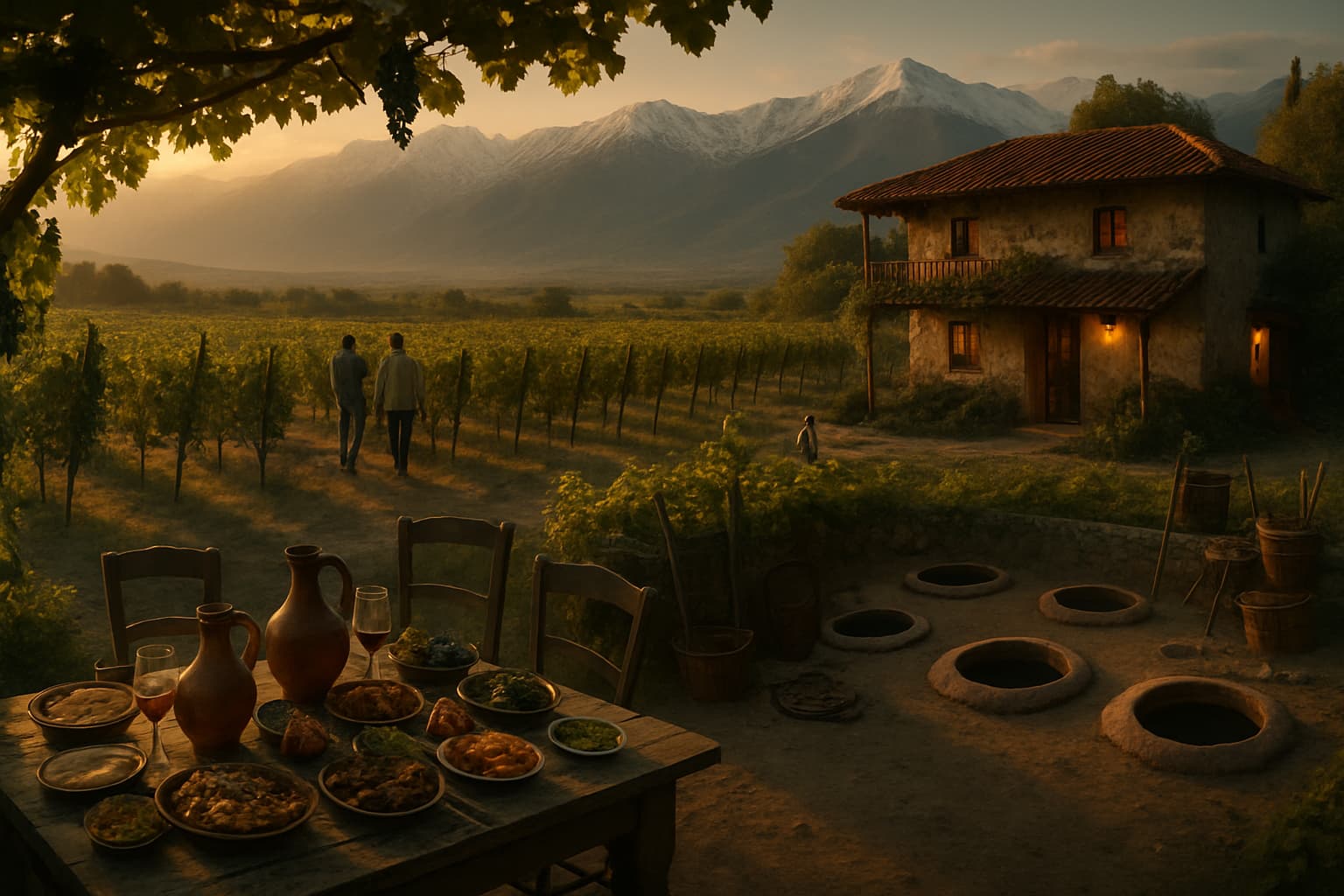
A qvevri is a large, egg-shaped clay vessel, lined with beeswax and buried in the earth. Grapes—skins, seeds, sometimes stems—are placed inside to ferment and mature, protected by the steady, cool embrace of the soil. This is winemaking as an act of patience and trust, leaving time and nature to do their slow, invisible work.
In 2013, UNESCO recognized the traditional Georgian qvevri winemaking method as part of the Intangible Cultural Heritage of Humanity. But long before it had a plaque or a certificate, it had something far more important: the devotion of the people of Kakheti, passing their skills from one generation to the next like a prayer.
Georgia has several wine regions, but Kakheti is its great, generous heart. It produces the majority of the country’s wine and is home to many of its most famous appellations.
Walk through Kakheti, and you move through a mosaic of microclimates and soils, each one shaping the grapes in its own quiet way.
The Alazani Valley is Kakheti’s broad, fertile stage, framed by the Greater Caucasus to the north and gentle hills to the south. The climate here is slightly warmer and more humid, perfect for late-ripening grapes and fuller, fruit-forward wines.
The valley is known for:
To the south and east, the terrain rises and shifts. Here, the soils can be rockier, the climate a bit drier, and the wines a little more structured and serious. Vineyards cling to slopes, and the air carries the scent of wild herbs and dust.
Kakheti is not a uniform landscape; it’s a patchwork quilt of terroirs. Each patch has its own voice, its own way of turning sunlight and rain into something you can hold in a glass.
In Kakheti, the grapes themselves are part of the story. These are not the usual names you see on supermarket shelves. These are native varieties, shaped by centuries of wind and weather, of wars and winters and harvests.
Saperavi is the pride of Georgian reds, and Kakheti is its kingdom.
Most red grapes have clear pulp; the color comes from the skins. Saperavi is different. It’s a teinturier grape, with red flesh and red juice. That gives it a deep, inky color and a powerful character.
In the glass, Saperavi can be:
In qvevri, Saperavi becomes something almost ancient: a wine that feels carved from stone and time, yet alive with energy.
On the white side, Rkatsiteli reigns—one of the oldest known grape varieties, a workhorse and an artist all at once.
Made in stainless steel or large neutral barrels, it can be:
But when Rkatsiteli is fermented with its skins in qvevri, it becomes something else entirely: an amber wine.
These “orange” or amber wines are:
Other native varieties—Kisi, Khikhvi, Mtsvane—add their own accents: floral, aromatic, sometimes exotic, always rooted in this land.
To understand wine tourism in Kakheti, you have to descend into the marani—the traditional Georgian wine cellar—and stand before the qvevri.
There, under a simple roof or beneath a family home, the floor opens into circles of clay-lined mouths. Each qvevri is a vessel of memory: of last year’s harvest, of a grandfather’s hands, of the first time a child was allowed to help press the grapes.
The process is deceptively simple:
When you stand in that cellar, listening to the winemaker explain this process, you’re not just hearing about technique. You’re hearing about continuity—about a culture that refused to abandon its way of making wine, even when empires tried to bend it to their will.
Kakheti’s story is not all romance and sunlight. There were hard years—centuries of invasion, occupation, and loss. Wine, like everything else, bore the scars.
During the Soviet period, the focus shifted toward mass production. Vineyards were pushed to prioritize volume over character. Ancient varieties were uprooted; traditional methods were discouraged or marginalized. Many qvevri were sealed, forgotten, or destroyed.
But some families held on. They kept a few qvevri in the ground, made a little wine the old way, and passed down the knowledge quietly, like a secret.
When Georgia regained its independence, those quiet keepers of tradition became the seeds of a renaissance. Today, Kakheti stands at a crossroads where old and new meet:
Wine tourism in Kakheti is, in many ways, a journey through this rebirth: seeing how a culture reclaims its oldest self and offers it to the world without losing its soul.
You cannot understand Georgian wine without experiencing a supra—the traditional feast.
Imagine a long table, heavy with dishes: khachapuri oozing with cheese, mtsvadi (grilled meat) smoking gently from the fire, pkhali made of spinach and walnuts, pickles, salads, stews, bread still warm from the oven. Pitchers of wine stand ready, red and amber, clear and shining.
At the head of the table sits the tamada, the toastmaster. His role is not just to raise a glass, but to guide the soul of the gathering. Toasts are not hurried or casual; they are small acts of storytelling.
He toasts:
Each toast is followed by a deep sip of wine, and each sip carries more than flavor. It carries meaning.
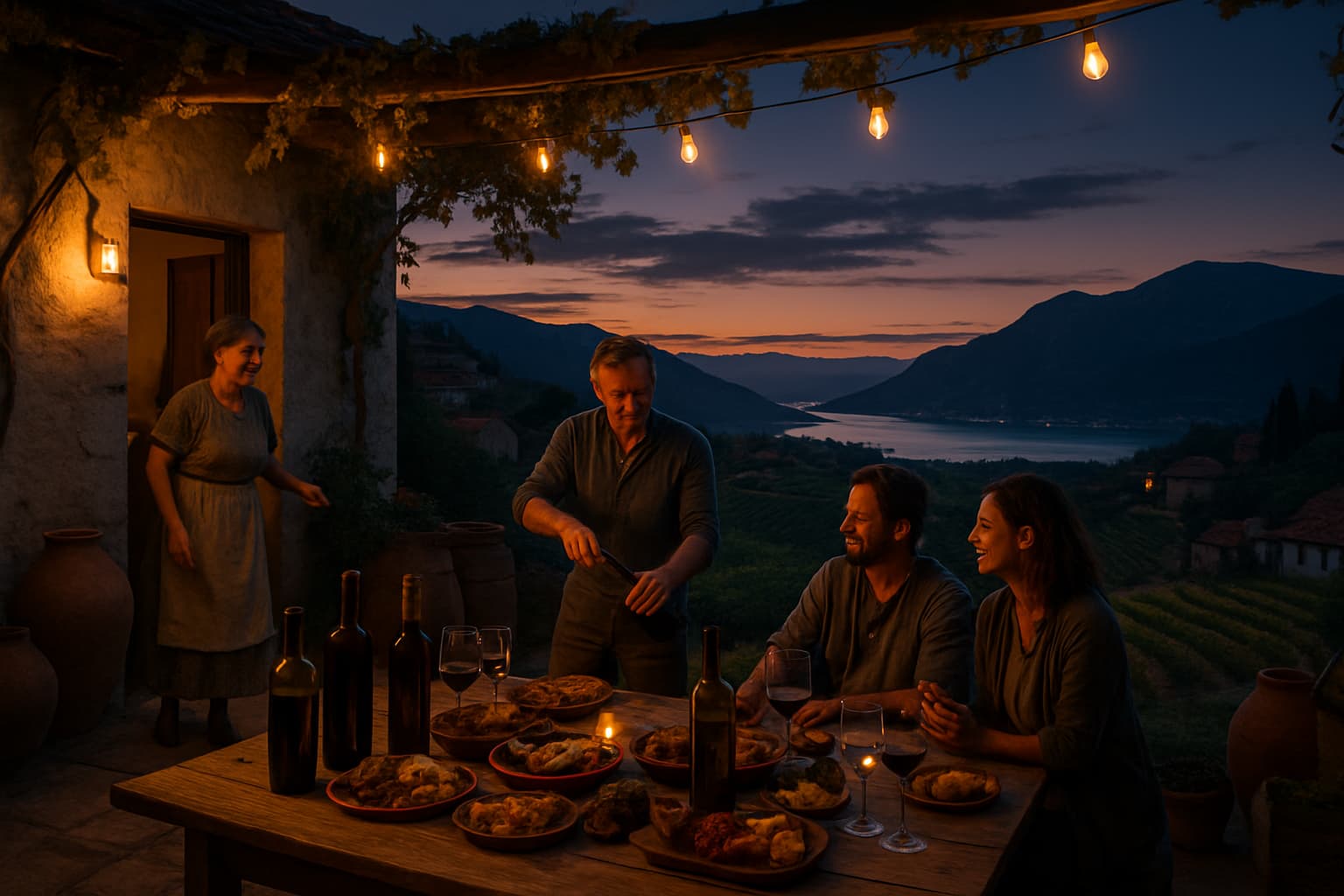
For a visitor, sharing a supra in Kakheti is often the moment when wine stops being just something you taste and becomes something you feel. It’s where the cradle of wine reveals itself not just in clay and grape, but in human connection.
Wine tourism in Kakheti is as varied as the people who welcome you.
You might spend one morning at a historic monastery like Alaverdi or Nekresi, where monks still tend vineyards and make wine in qvevri, their craft woven into centuries of prayer and contemplation.
In the afternoon, you may find yourself at a small family winery, where the “tasting room” is a wooden table under a grape arbor, and the winemaker’s grandmother insists you try just one more piece of homemade cheese.
Another day might lead you to a modern estate—polished, architecturally bold, with terraces overlooking the Alazani Valley. There, you taste Saperavi aged in oak barrels, amber wines in qvevri, and experimental blends that point to the future.
Across these experiences, a few threads remain constant:
If you decide to follow this road to the cradle of wine, a few simple truths will serve you well:
Wine here is not a checklist. It’s an invitation.
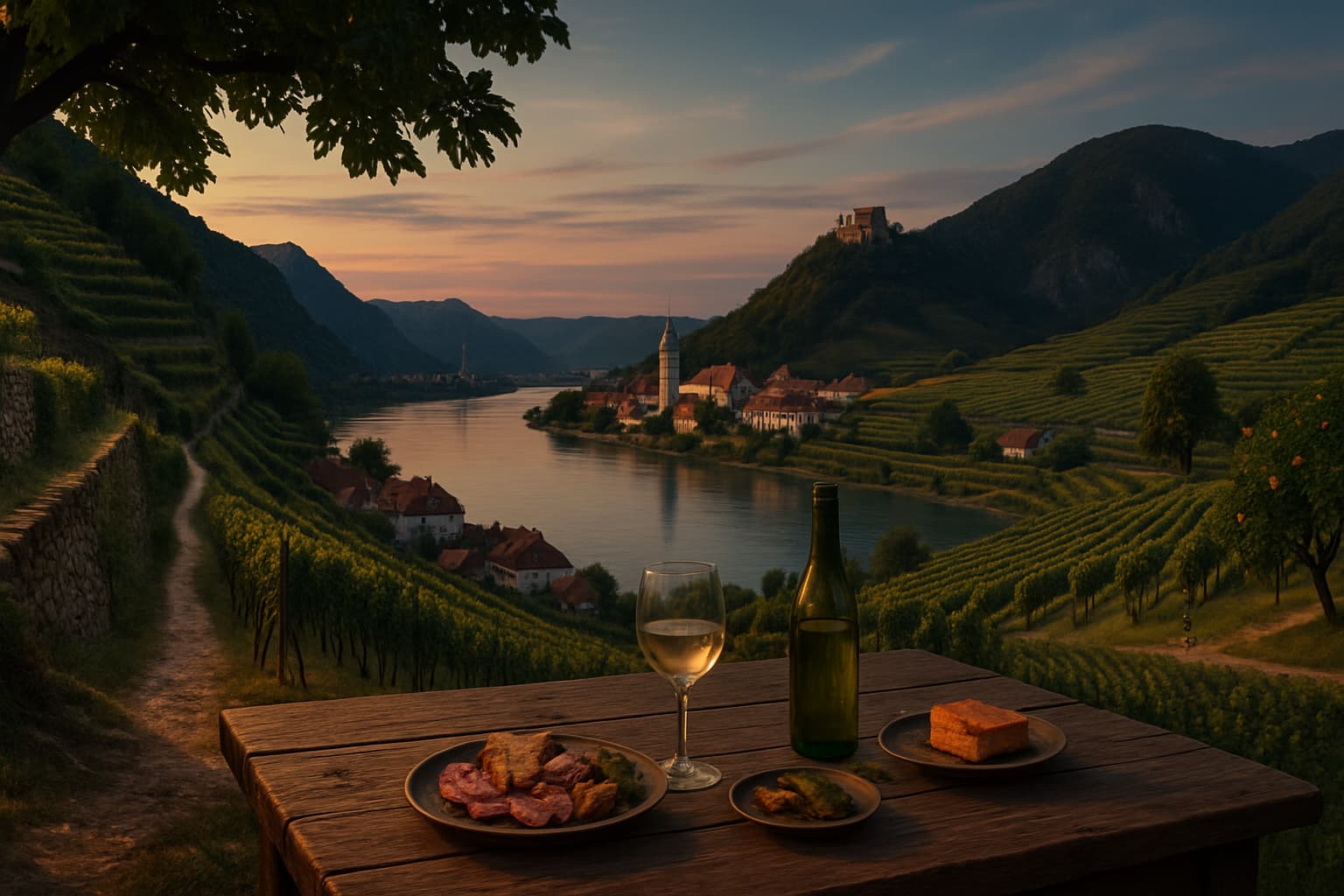
Stand at the edge of a Kakhetian vineyard at sunset. The sky turns gold, then amber, then the deep red of a well-aged Saperavi. The mountains fade into silhouettes, and the air cools as the day exhales.
In that quiet, you begin to understand something simple and profound: wine, at its best, is a way of remembering who we are.
In Kakheti, the cradle of wine is not just a claim of origin. It is a reminder that human beings have always searched for ways to preserve sunlight and season, joy and sorrow, in forms we can share with one another. Clay vessels buried in the earth. Grapes turned to liquid memory. Tables where strangers become friends.
Wine tourism here is not about chasing the next tasting or the rarest bottle. It is about stepping into a story that began long before you arrived and will continue long after you leave—and, for a brief, shimmering moment, becoming part of it.
You come to Kakheti to taste wine.
You leave with something far deeper: a sense that, somewhere between earth and sky, vine and clay, glass and hand, we have found one of the oldest and most beautiful ways to say, “We are here. We were here. And we shared this.”
Tannins are astringent compounds found in wine that contribute to its texture and aging potential, often causing a drying or puckering sensation in the mouth. They are derived from grape skins, seeds, and stems, as well as from oak barrels used during aging.
/ˈtænɪnz/
Malic acid is a naturally occurring organic acid found in grapes that contributes to the tart, green apple-like flavor and crispness in wine. It plays a significant role in the taste and acidity of wine.
/mælɪk ˈæsɪd/
Filtration in winemaking is the process of removing solid particles from wine to clarify and stabilize it before bottling, using various types of filters to achieve different levels of clarity and remove unwanted elements like yeast, bacteria, and sediment.
/fɪlˈtreɪʃən/
Oxidation in wine is a chemical reaction between the wine and oxygen that can change its flavor, aroma, and color. This process can be beneficial or detrimental depending on the extent and context of the exposure.
/ˌɒksɪˈdeɪʃən/
Microclimate refers to the unique climate conditions of a small, specific area within a larger region, significantly influencing grapevine growth and the characteristics of the resulting wine.
/ˈmīkrōˌklīmit/
Get weekly wine recommendations, vineyard news, and exclusive content delivered to your inbox.