Wine Tourism
“Where every bottle tells a story”
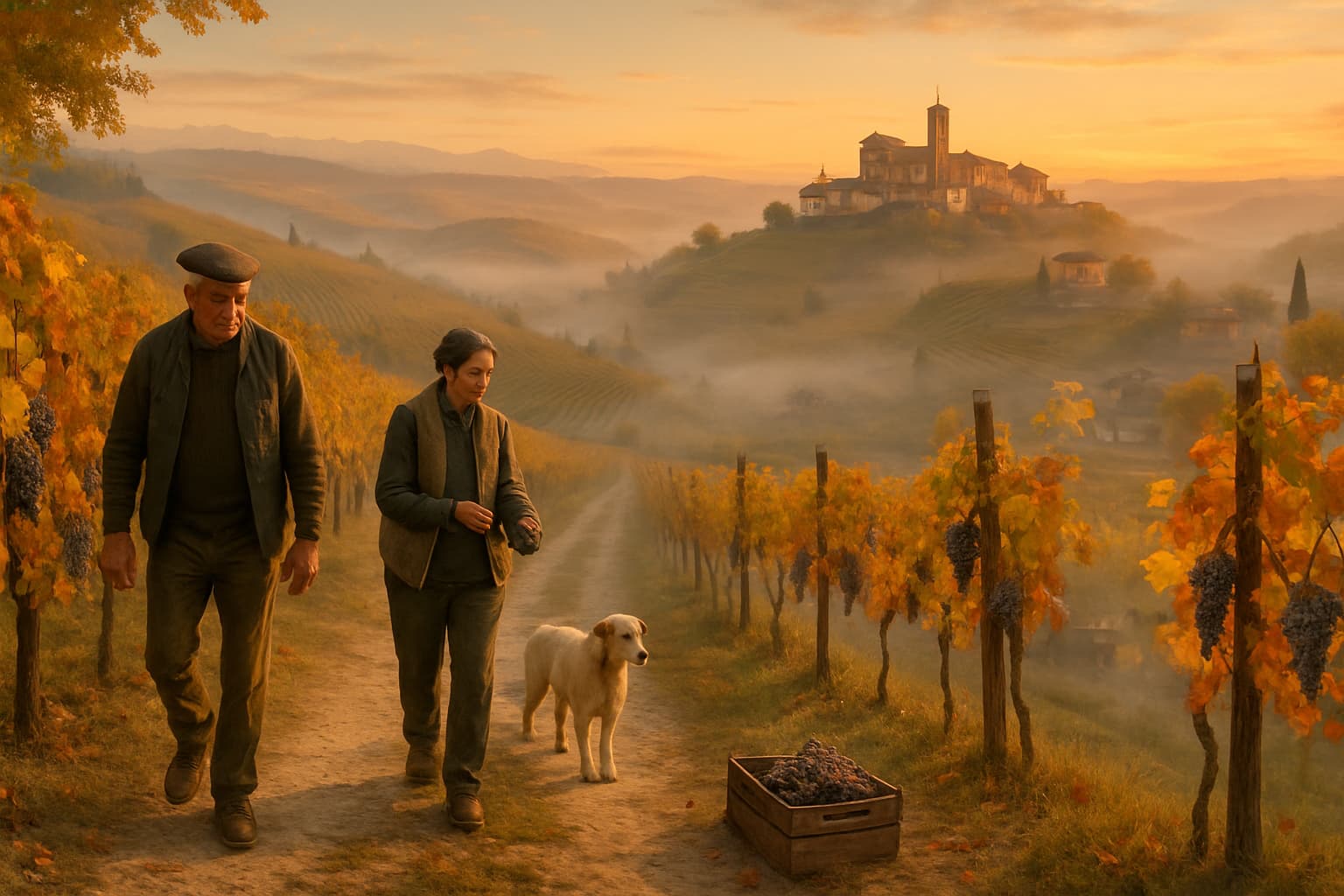
The road into Piedmont runs through fog. It lies low in the hollows and clings to the vineyards, and in the mornings it makes the hills look like islands in a white sea. The vines stand in rows on those hills, black and bare in winter, heavy and green in summer, and in the fall the grapes hang thick and purple and the air smells of must and wet earth. Men and women move through the rows with stained hands. They do not talk much. They work.
You come there because of the wine. But if you stay, it is because the place takes hold of you: the hills, the fog, the slow meals, the steady patience of people who know that good things take time. Wine tourism in Piedmont is not only about tasting. It is about learning to move at the pace of a vine.
Piedmont lies in the northwest corner of Italy. The Alps guard its back. The plains run out toward the Po River. Between the mountains and the flatlands, the land folds into soft hills. These are the Langhe, Roero, and Monferrato. The names sound like old stories. They are.
In these hills, the villages sit on crests like watchtowers: Barolo, Barbaresco, La Morra, Neive, Monforte d’Alba. Their stone houses crowd around bell towers and small piazzas. At night, the towns glow like small ships in a dark sea. In the morning, you wake and step out to see the fog rolling in the valley below.
For the traveler, this is the heart of Piedmont’s wine country. The distances are small. You can drive from one hill town to the next in ten or fifteen minutes. But each slope, each exposure, each patch of soil has its own character. The people here have spent generations learning those differences. They do not hurry when they speak of them.
There are many grapes in Piedmont, but a few rule the hills and the tables.
Nebbiolo is the stubborn king. It buds early and ripens late. It wants the best hillsides, the ones that face south or southwest, with slopes that drain and soils that hold enough but not too much water. It gets its name from the nebbia, the fog that settles over the vineyards in autumn when the grapes are ready.
From Nebbiolo, they make Barolo and Barbaresco. These are not easy wines. Young, they can be hard and closed, with tannins that grip your gums. But in the glass they open slowly: roses, tar, truffle, cherry, leather. They are wines built for time and for food, not for quick pleasure.
In the cellars, the debate over Nebbiolo has gone on for decades: old oak or small barriques, long macerations or shorter, gentler ones, modern or traditional. Tourists hear these words in the tasting rooms. The winemakers shrug. They have their ways. They know their vines. They pour you a glass and wait.
Barbera is the wine people drink when they are thirsty. It grows in many places in Piedmont—in Asti, in Alba, in Monferrato. It has high acidity and low tannin. It tastes of red cherries and plums and sometimes a little spice. You drink it with salami, with tajarin pasta, with grilled meat. It is a wine for long lunches and loud dinners.
There are simple Barberas, fresh and light, meant to be drunk young. There are also serious ones, aged in oak, with depth and structure. In Monferrato and Asti, some producers treat Barbera with the same respect others give to Nebbiolo. You taste these and see that a “simple” grape can have its own quiet nobility.
Dolcetto is dark and easy to drink. Despite its name, it is not sweet. It is the wine the farmers used to drink every day: soft tannins, black fruit, a touch of bitter almond. It goes well with simple food—cheese, bread, sausage.
There are also white grapes—Cortese in Gavi, Arneis in Roero, Favorita and Nascetta in the Langhe. They give wines with clean lines and fresh acidity, good for the hot days when the sun beats down on the vines and the stones in the vineyards burn your hands.
If you care about wine, you go to Barolo and Barbaresco the way some people go to Santiago or Rome.
Barolo is not large. It is a small village with a castle, a few streets, and many cellars. Around it, the vineyards spread over eleven communes. The names of the crus are written on maps and on the lips of collectors: Cannubi, Brunate, Monprivato, Rocche, Bussia. These are not just plots of land. They are stories of exposure, soil, and hands.
You drive the narrow roads between La Morra, Castiglione Falletto, Serralunga d’Alba, and Monforte. Each hill has its own view. Each slope its own light. You can walk between villages on paths that cut through the vines. The dirt is pale and dusty in some places, darker and heavier in others. The winemakers talk of marl, sandstone, clay, and limestone. You see it under your boots.
In the tasting rooms, you taste Barolo from different crus and vintages. One is stern and vertical. Another is broad and rich. The same grape, the same region, but different faces. The people pouring the wine do not use big words. They point out the window to the hill where the grapes grew. That is enough.
Barbaresco lies to the northeast, closer to the Tanaro River. The hills are softer, the air a little cooler. The wines, some say, are more graceful. They ripen a bit earlier. They show their charm sooner.
The villages of Barbaresco, Neive, and Treiso stand among the vines. From the tower in Barbaresco, you can see the river and the patchwork of vineyards. The crus here—Rabajà, Asili, Martinenga, Montestefano—are smaller and more intimate. You taste the wines and feel Nebbiolo’s power, but it is wrapped in silk instead of leather.
For the traveler, Barbaresco is quieter than Barolo: fewer buses, fewer crowds, but the same seriousness in the cellars, the same pride in the land.
In Piedmont, wine tourism is still close to the farm. Many wineries are family-run. The person who greets you at the door may be the same one who pruned the vines in winter or drove the tractor at harvest.
You do not simply show up at most serious estates and expect a grand performance. You write, or you call. You fix a time. When you arrive, you park by the house or the shed. A dog may bark. Someone wipes their hands and comes to greet you.
The visit is not a show. It is a walk through the cellar, the barrels, the concrete tanks, the bottling line. You smell yeast and wood and damp stone. You hear the hum of compressors and the drip of water. You see old casks stained dark with age and new ones pale and clean.
Then you sit at a table or stand at a counter. The bottles appear. The glasses fill. The winemaker watches you as you taste. There is no hurry. They talk about the year: the rains, the heat, the hail that came in August and broke their hearts. They talk about their father or grandfather and how things were done then.
You taste Barbera before Barolo. You taste Dolcetto, maybe a white. You move from younger Nebbiolos to older ones. You see how time changes the wine. You learn that a good vintage is not just a number on a label but a memory of weather and work.
Sometimes you buy bottles. Sometimes you do not. They do not push. They know that if the wine speaks to you, you will find a way to take it home.
In Piedmont, you do not drink without eating. The food is as serious as the wine, and it is built for it.
In autumn, the white truffle comes out of the ground. Men go into the woods at night with their dogs. They come back with knotted, pale things that smell of garlic, cheese, and wet leaves. In Alba, during the truffle fair, the streets fill with this smell. It gets into your clothes, your hair, your dreams.
You sit at a table and they shave the truffle over tajarin, the thin egg pasta of the region. The pasta is soft and rich. The truffle is sharp and wild. You drink Barolo or Barbaresco and the wine cuts through the fat and lifts the earthiness of the truffle. You understand then why these things grew up together in this place.
There are other dishes, less famous but just as true. Vitello tonnato: thin slices of veal under a sauce of tuna, capers, and mayonnaise. Carne cruda: raw chopped beef dressed with oil and lemon. Bagna cauda: a warm dip of anchovy, garlic, and olive oil, served with raw vegetables. Brasato al Barolo: beef braised long and slow in red wine until it falls apart.
These foods are not fancy on the plate. They are honest. They were made to feed people who worked hard in the fields and needed strength. With the wines of the region, they make a complete circle.
The vines mark the time in Piedmont, and each season offers a different face.
In spring, the hills are bright green. The vines bud and the air is sharp. It is quiet then. You can drive the roads and find space in the tasting rooms. The wines taste clean and young.
In summer, the sun is strong. The grapes swell. The days are long and hot. You sit in the shade with a glass of Arneis or Gavi and watch the heat shimmer over the rows. There are festivals, open-air dinners, music in the piazzas.
In autumn, the harvest comes. Tractors move up and down the hills. People cut the grapes in the early morning and late afternoon, when the sun is not too fierce. The leaves turn yellow and red. The air smells of fermentation. This is the time of truffles and long lunches. It is also the busiest time. You must plan ahead.
In winter, the vines are bare and black against the snow-dusted hills. The fog stays longer in the valleys. It is a good time to see the bones of the land. The tasting rooms are quiet. The wines seem more serious. You eat hearty stews and feel the warmth of Barolo in your chest.
Wine tourism in Piedmont is not only about pleasure. It is about understanding a way of life built on patience, risk, and faith in the land.
The people here know that they are not in control. A storm can ruin a year. A frost can kill buds in a night. Hail can tear the leaves and split the grapes. They work anyway. They prune in the cold. They tie the shoots in the wind. They pick in the rain.
When you stand on a ridge above Barolo or Neive and look at the patchwork of vineyards, you see more than rows of vines. You see time stacked on time. Grandfathers planted some of those vines. Sons and daughters tend them now. The wines you taste are not just flavors. They are the record of seasons, choices, accidents, and stubbornness.
You come as a tourist. You drive the roads, take the pictures, taste the wines. If you pay attention, you leave with something more. You learn that good things are slow, that depth comes from repetition and care, that the land gives, but only to those who stay and work and wait.
When you drive out of Piedmont, the hills fall away behind you. The fog stays in the valleys. The vineyards are only a memory in the rearview mirror. The bottles in your trunk clink softly when you turn.
You will open them later, in some other place, far from the Langhe or Monferrato. The cork will come out with a small, tired sigh. The wine will hit the glass and you will see its color, smell its nose. If you have paid attention, you will also see the slope where it grew, the morning fog, the man in the cellar, the dog in the courtyard, the woman shaving truffles over your plate.
That is the real gift of wine tourism in Piedmont. It is not only the taste of the wine. It is the way a distant hillside can live on in your glass and, for a moment, in you.
Tannins are astringent compounds found in wine that contribute to its texture and aging potential, often causing a drying or puckering sensation in the mouth. They are derived from grape skins, seeds, and stems, as well as from oak barrels used during aging.
/ˈtænɪnz/
Malic acid is a naturally occurring organic acid found in grapes that contributes to the tart, green apple-like flavor and crispness in wine. It plays a significant role in the taste and acidity of wine.
/mælɪk ˈæsɪd/
Filtration in winemaking is the process of removing solid particles from wine to clarify and stabilize it before bottling, using various types of filters to achieve different levels of clarity and remove unwanted elements like yeast, bacteria, and sediment.
/fɪlˈtreɪʃən/
Oxidation in wine is a chemical reaction between the wine and oxygen that can change its flavor, aroma, and color. This process can be beneficial or detrimental depending on the extent and context of the exposure.
/ˌɒksɪˈdeɪʃən/
Microclimate refers to the unique climate conditions of a small, specific area within a larger region, significantly influencing grapevine growth and the characteristics of the resulting wine.
/ˈmīkrōˌklīmit/
Get weekly wine recommendations, vineyard news, and exclusive content delivered to your inbox.