Wine Tourism
“Where every bottle tells a story”
In the far northeastern corner of the Iberian Peninsula, where the Pyrenees descend in a cascade of stone and scrub toward the Mediterranean Sea, there lies a landscape in which time, geology and human patience have conspired to create something quite extraordinary. Here, in Priorat and the broader lands of Catalonia, wine is not merely a drink. It is a distillation of rock and light, of wind and silence; a chronicle of centuries written not in ink, but in roots, leaves and fruit.
Let us step quietly into this world—into terraces carved by hand, into cellars dug from the earth, into villages whose bells have tolled through war, famine and rebirth—and discover what it means to journey through wine in this singular corner of the planet.
To understand wine tourism in Priorat and Catalonia, we must begin not with the glass, but with the ground beneath our feet.
Catalonia is a mosaic of landscapes: rugged coastal cliffs, rolling inland plains, cool mountain valleys and sun-drenched river terraces. Across this region, vines cling and spread, adapting themselves with remarkable tenacity to each subtle shift in altitude, soil and climate.
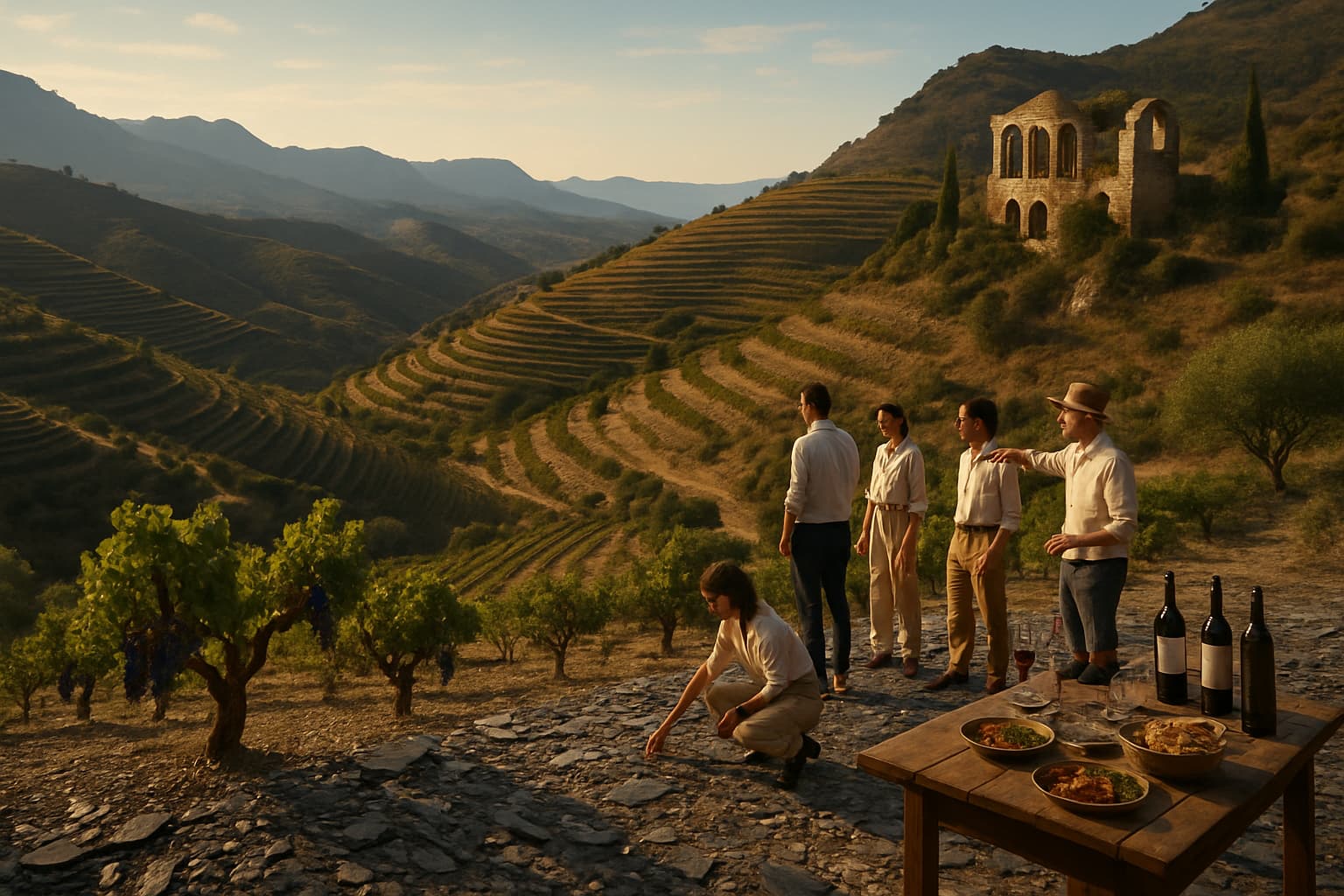
But in Priorat in particular, the earth itself seems almost to resist cultivation. Here, the hills are steep, the paths narrow, and the soil is not soft loam but broken slate—known locally as llicorella—shimmering black and ochre in the fierce Mediterranean light. It fractures easily, like pages of an ancient book, and within its cracks, vine roots descend, sometimes ten metres or more, in search of water and sustenance.
For the wine traveller, this is not simply scenery. It is the very stage upon which the drama of Priorat is played out. To walk these vineyards is to witness a slow-motion battle between plant and stone, hardship and reward.
Centuries ago, long before the modern wine tourist traced these paths, another group of travellers arrived: Carthusian monks. In the 12th century, they established the Cartoixa d’Escaladei—“Stairway to God”—a monastery that would become the spiritual and agricultural heart of the region.
The monks, masters of patience and observation, studied the slopes, the winds, the variations in soil. They planted vines where others might not have dared, terracing the hillsides and taming the rugged terrain with stone walls and quiet persistence. Over time, their work transformed Priorat into a place where wine became the lifeblood of local existence.
Visiting the ruins of Escaladei today, one can almost hear the echo of their footsteps in the cloisters. Many wine routes in Priorat begin or end here, for this is not just a historic site; it is the cradle of the region’s viticultural identity. To stand amid these arches and broken walls, with vineyards stretching out in every direction, is to feel the deep continuity between past and present—a continuity that defines the very essence of wine tourism in this region.
If one region in Catalonia has captured the imagination of wine lovers around the world, it is Priorat. For the traveller, this small, mountainous appellation offers an experience of rare intensity.
The wines of Priorat are not timid. They are forged in heat and scarcity, in poor soils and low yields. The primary grapes—Garnatxa (Grenache) and Carinyena (Carignan)—are often drawn from old vines, their trunks twisted and gnarled, bearing witness to decades of struggle.
From these vines come wines of remarkable concentration: dark, mineral, often with aromas of black fruit, licorice, Mediterranean herbs and a distinctive, almost smoky stoniness that seems to speak directly of the llicorella itself. To taste such a wine in the very vineyard where it was born is to experience terroir not as an abstract concept, but as something palpable, immediate, almost visceral.
For the visitor, Priorat is best discovered slowly—on foot, by bicycle, or along the winding roads that connect its tiny villages: Gratallops, Porrera, La Vilella Baixa, La Morera de Montsant and others. As you ascend the terraced hillsides, each step reveals a different angle of the landscape: a new pattern of vines, a distant church tower, a ribbon of road clinging precariously to the slope.
Many wineries here are small, family-run estates. A visit often begins not in a gleaming, modern tasting room, but in a courtyard or a simple cellar cut into the hillside. The people who greet you are frequently those who pruned the vines, who rose before dawn to harvest, who watched the fermentations day and night. Their stories—of grandparents who abandoned the land, of a new generation who returned, of the rebirth of Priorat in the late 20th century—form an essential part of the experience.
Encircling Priorat like a great horseshoe of stone lies another appellation: Montsant. Its name, “Holy Mountain,” hints at the spiritual and geological grandeur of the area.
While sharing some of Priorat’s grape varieties and Mediterranean climate, Montsant often offers a slightly softer, more approachable expression of the land. Its soils are more varied—clay, limestone and some pockets of llicorella—and its slopes, though still dramatic, are sometimes more forgiving.
For the wine tourist, Montsant can be a revelation: a place where quality is high, prices are often more accessible, and the welcome is warm. The wines, frequently a blend of Garnatxa, Carinyena and sometimes international varieties such as Syrah or Cabernet Sauvignon, can range from bright and red-fruited to deep and structured, always with a whisper of the wild thyme, rosemary and pine that surround the vineyards.
Many visitors choose to explore Priorat and Montsant together, tracing a loop that reveals how subtle changes in geology and exposure can yield profoundly different wines, even within a few kilometres.
Yet the story of wine tourism in Catalonia does not end in these rugged inland hills. The region as a whole is a tapestry of appellations, each with its own character, climate and traditions.
To the southwest of Barcelona, the Penedès region stretches toward the sea. Here, the light is softer, the plains broader, and the vineyards more expansive. This is the heartland of Cava, Spain’s renowned traditional-method sparkling wine.
Visitors to Penedès can wander from one grand estate to another, descending into cool, labyrinthine cellars where millions of bottles quietly undergo their second fermentation. The atmosphere is almost subterranean, cathedral-like: rows of dark glass receding into the distance, the faint scent of yeast and chalk in the air.
But Penedès is not only about sparkling wine. It has become a hub of experimentation and sustainability, with many producers embracing organic and biodynamic viticulture, reviving forgotten local varieties and redefining what Catalan wine can be. Tastings here might include everything from crisp, saline whites to complex, oak-aged reds and elegant rosés.
Further north, near the French border, lies Empordà—a region where the vineyards are caressed (and sometimes battered) by the Tramuntana wind. Here, the landscape is one of cork oak forests, olive groves and rocky shores, with vines planted on terraces that gaze out toward the Mediterranean.
Empordà’s wines reflect this interplay of sea and mountain: fresh, often with a certain salinity and lift, yet grounded in the warmth of the Mediterranean sun. For the traveller, this is a region where wine routes intertwine with visits to medieval villages, Dalí’s surrealist legacy and coastal paths that trace the contours of hidden coves.
Wine tourism in Priorat and Catalonia is not a static experience; it changes with the turning of the seasons.
Wine tourism here is not confined to tasting rooms. It is a multi-sensory journey, offering countless ways to engage with the land and its people.
In Priorat and Montsant, many estates offer guided walks through their vineyards, explaining the geology, the pruning methods, the challenges of farming on steep slopes. Some offer 4x4 tours that climb to dizzying viewpoints, where you can gaze down upon a patchwork of terraces and see, in a single glance, the enormity of human effort required to coax vines from such forbidding terrain.
Wine here is inseparable from food. In village restaurants and winery kitchens, visitors may find themselves tasting robust reds alongside calçots (charred spring onions dipped in romesco sauce), grilled lamb or hearty stews perfumed with local herbs. Olive oil, often produced on the same estates as the wine, adds another layer of terroir to the table.
Pairing experiences, where each course is matched to a different wine, allow travellers to understand how Catalan cuisine and Catalan wine have evolved together, each enhancing the other across generations.
Throughout Catalonia, wine routes intersect with layers of history: Roman ruins that recall the earliest days of viticulture on these shores; Romanesque chapels perched above vineyards; medieval castles guarding old trade routes. In Priorat, the spiritual echo of the Carthusians lingers still; in Montsant, hermitages cling to cliffs, silent witnesses to centuries of devotion.
For many visitors, these encounters transform their journey from simple tourism into a deeper reflection on time, continuity and the enduring relationship between humans and the land.
As the climate changes and pressures on the land increase, Priorat and Catalonia stand at a crossroads. Many producers are responding with remarkable foresight: converting to organic or biodynamic farming, reducing water use, preserving ancient bush vines and protecting biodiversity within and around their vineyards.
For the traveller, this means that a visit is not only an exploration of tradition, but also a glimpse into the future of wine. Conversations in cellars often turn to questions of resilience: Which grape varieties will withstand rising temperatures? How can soil health be maintained on steep, erosion-prone slopes? How can human activity harmonise, rather than clash, with the natural world?
In witnessing these efforts, one becomes not merely a spectator but, in some small way, a participant in a broader story—the story of how a region adapts and endures.
In the end, wine tourism in Priorat and Catalonia is not about the number of wineries visited, nor the tally of bottles purchased. It is about learning to listen.
Listen to the crunch of slate beneath your boots in a Priorat vineyard; to the wind threading its way through Empordà’s coastal hills; to the stillness of a Penedès cellar where sparkling wines slowly mature in the dark. Listen to the voices of those who farm the land, who remember when vines were abandoned, and who have lived to see them cherished once more.
When you finally raise a glass—whether it holds a deep, mineral Priorat red, a bright Montsant blend, a shimmering Cava from Penedès or a coastal white from Empordà—you are not merely tasting fermented grape juice. You are tasting a season, a soil, a slope, a culture. You are tasting geology and history, labour and love.
And as the wine moves across your palate, you may find, if you are very still, that you can sense the contours of the land itself: the heat of the sun on a slate terrace, the cool of evening descending over a monastery ruin, the patient, age-old dialogue between human hands and the stubborn, beautiful earth.
For those who journey here with open eyes and a curious mind, Priorat and Catalonia offer not just a destination, but an awakening—a reminder that in a single glass of wine, an entire landscape may speak.
Tannins are astringent compounds found in wine that contribute to its texture and aging potential, often causing a drying or puckering sensation in the mouth. They are derived from grape skins, seeds, and stems, as well as from oak barrels used during aging.
/ˈtænɪnz/
Malic acid is a naturally occurring organic acid found in grapes that contributes to the tart, green apple-like flavor and crispness in wine. It plays a significant role in the taste and acidity of wine.
/mælɪk ˈæsɪd/
Spring brings a tender green to the vines, a sense of awakening. It is a quieter time, when you may have vineyards and tasting rooms almost to yourself. The temperatures are gentle, the hillsides dotted with wildflowers.
Summer intensifies everything: the heat, the light, the aromas of herbs and dust. Days are long, evenings warm. In Priorat, the sun can be fierce, but the views from the highest terraces, as the light softens toward dusk, are unforgettable.
Autumn, perhaps the most evocative season, is when the harvest—la verema—takes place. Grapes are picked in the cool of early morning; tractors and trailers rumble along narrow roads; the air in the cellars is thick with the scent of fermentation. To visit at this time is to witness the climax of the viticultural year, though it is also a period of intense work, and appointments must be made with care.
Winter strips the vines bare, revealing the stark architecture of trunks and canes against a pale sky. It is a contemplative season, ideal for those who seek quiet, in-depth conversations with winemakers and a deeper understanding of the cycle of the vine.
Filtration in winemaking is the process of removing solid particles from wine to clarify and stabilize it before bottling, using various types of filters to achieve different levels of clarity and remove unwanted elements like yeast, bacteria, and sediment.
/fɪlˈtreɪʃən/
Oxidation in wine is a chemical reaction between the wine and oxygen that can change its flavor, aroma, and color. This process can be beneficial or detrimental depending on the extent and context of the exposure.
/ˌɒksɪˈdeɪʃən/
Microclimate refers to the unique climate conditions of a small, specific area within a larger region, significantly influencing grapevine growth and the characteristics of the resulting wine.
/ˈmīkrōˌklīmit/
Get weekly wine recommendations, vineyard news, and exclusive content delivered to your inbox.