Wine Tourism
“Where every bottle tells a story”
There are places on this earth where time seems to loosen its grip, where landscape, water, and human endeavour weave together into a single, enduring story. Along the winding courses of the Mosel and Saar rivers in western Germany, such a story unfolds—one written on slate, in vines, and in the quiet patience of those who have tended them for generations.
Here, wine tourism is not merely a pleasant pastime. It is a way of entering an ancient dialogue between geology and climate, between human hands and the slow, inexorable forces of nature.
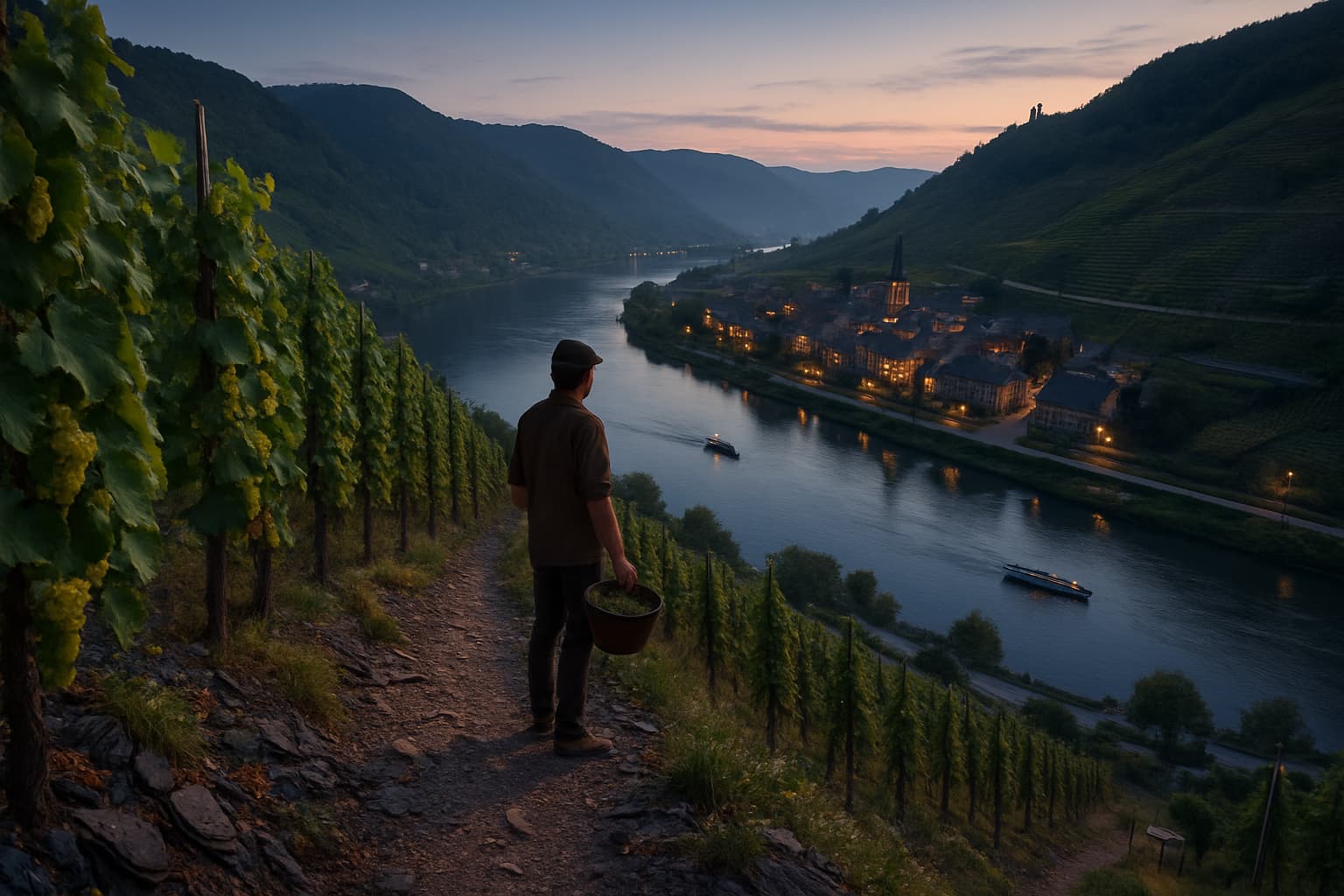
Imagine, if you will, an aerial view: a serpentine river curling through steep, forested hills, its surface catching the light like a strip of polished metal. On either bank, vineyards cling to slopes so precipitous that they seem almost vertical, their ordered rows defying gravity and common sense.
This is the Mosel, joined by its quieter, more introspective sibling, the Saar. Over millions of years, these rivers have carved deep valleys into ancient slate and sandstone, exposing the very bones of the earth. Upon these fractured stones, vines root themselves, probing deep for water and minerals, transforming rock into flavour.
For the traveller, this is no ordinary wine region. It is a living geological museum, a cultural landscape where every terrace, every dry-stone wall, and every weather-beaten vine tells a chapter of a story that stretches back to Roman times.
To understand wine tourism on the Mosel and Saar, one must first understand the vine that reigns here: Riesling.
Riesling is, in many ways, a lens through which this landscape becomes visible on the tongue. It is transparent—not in colour, but in character—revealing rather than masking the conditions in which it grew. On the Mosel and Saar, those conditions are nothing short of extraordinary.
The vineyards here are among the steepest in the world, some reaching gradients of 60–70 percent. They face the river, catching every available ray of sun in a cool, northern climate. Underfoot lies slate—blue, grey, red, and even black—shattered into shards that absorb heat by day and release it slowly by night, cradling the grapes in a gentle warmth.
As you walk through these vineyards, you may notice how the stones glitter, how they crunch beneath your feet. This slate, once part of ancient seabeds, now bestows upon the wines a curious combination of delicacy and intensity: aromas of white flowers and citrus; flavours of green apple, peach, and lime; and, always, a subtle, stony echo—like rainwater over rock.
Visitors soon discover that Riesling here is not one wine, but many:
To taste your way along the Mosel and Saar is to experience how a single grape variety can mirror every nuance of slope, soil, exposure, and human intention.
Following the Mosel from its upper reaches toward the Rhine is to embark on a slow voyage through both space and time. Villages appear like pearls along a necklace, each with its church spire, its half-timbered houses, its patchwork of surrounding vineyards.
At the western gateway stands Trier, Germany’s oldest city, founded by the Romans over two thousand years ago. Here, massive stone gates, baths, and amphitheatres remind us that long before modern tourists, Roman soldiers and merchants drank Mosel wine.
In Trier, wine tourism is intertwined with archaeology. One can:
Further downstream lies Bernkastel-Kues, a town that seems to have stepped from the pages of a fairy tale. Its marketplace, framed by crooked, timbered houses, is watched over by the ruins of Landshut Castle high above, and by vineyards that cascade down impossibly steep slopes.
Nearby, one encounters legendary sites such as the Bernkasteler Doctor, a vineyard whose name recalls a medieval tale: a prince, gravely ill, said to have been cured by the wine grown on this very hill. Whether true or not, the wines from these slopes possess a remarkable combination of sweetness, acidity, and mineral tension that can feel, to the senses, almost medicinal in their restorative power.
As you continue along the river, names appear that resonate deeply in the world of wine:
Each of these vineyards, often marked by old sundials or carved stone signs, occupies a specific bend of the river, a particular angle to the sun, a unique configuration of slate and subsoil. For the curious traveller, visiting them becomes a kind of pilgrimage—standing at the foot of a slope, tasting the wine that springs from it, and sensing the direct line between rock, vine, and glass.
If the Mosel is a river of drama and spectacle, the Saar is a quieter, more contemplative presence. It branches away into a narrower valley, where the air is cooler and the growing season often more precarious.
Here, the wines can be even more ethereal. Saar Rieslings are often described as filigreed, like fine lacework: piercing acidity, delicate fruit, and an almost weightless structure that seems to hover rather than rest on the palate.
In villages such as Saarburg, Wiltingen, and Ockfen, you will find:
The Saar rewards the patient visitor. Mists rise from the river in the early morning, and the hills glow with a subdued, silvery light. To taste wine here, in a cool cellar carved from stone, is to feel the fragility and resilience of viticulture at the northern edge of possibility.
Wine tourism on the Mosel and Saar is not confined to scenery and tasting notes. It is, at its heart, a series of encounters—with people whose lives are inseparable from the slopes above their homes.
On these vertiginous hillsides, machines can do little. Much of the work must be carried out by hand:
Visitors who walk a few metres into these vineyards quickly appreciate the physical demands involved. Each bottle, they realise, is not merely a product of nature but of human perseverance—of countless journeys up and down the hill.
Many estates, from small family wineries to internationally renowned houses, welcome guests into their tasting rooms and cellars. Here, beneath vaulted ceilings and between rows of quietly ageing bottles, conversations unfold:
These moments—intimate, unhurried—reveal that wine, for those who make it here, is not a luxury commodity but a form of storytelling. Every bottle is a message from a particular slope, in a particular year, interpreted through the experience of a particular family.
The landscape invites exploration at many paces, each revealing different aspects of this riverine world.
River cruises, from short excursions to multi-day journeys, allow travellers to see the vineyards as merchants once did: rising steeply from the water’s edge, like amphitheatres of green.
A network of walking and cycling trails threads through vineyards, forests, and villages:
At such close quarters, one notices the small details: wildflowers between the rows, lizards basking on warm slate, the hum of insects—reminders that these vineyards are not isolated monocultures, but part of a broader ecological tapestry.
The wines of the Mosel and Saar find their fullest expression when paired with the region’s cuisine:
Many villages host seasonal wine festivals, where long tables fill the streets and locals and visitors alike share glasses, songs, and stories late into the evening. These gatherings remind us that wine, for all its complexity, is ultimately a social bond—a way of bringing people together.
Each season along the Mosel and Saar offers its own distinct character:
For the wine traveller, autumn holds a special allure, offering a glimpse of the region at its most industrious and celebratory. Yet in truth, the Mosel and Saar reward attention in any month of the year.
To journey through the Mosel and Saar as a wine tourist is to witness a rare equilibrium. Here, human beings have not conquered nature, nor left it untouched. Instead, they have entered into a long, delicate negotiation with the land and its rivers.
In return, humans have offered care: terracing the slopes, tending the vines, and passing on knowledge from one generation to the next. The result is a landscape that is both cultivated and wild, ordered yet profoundly shaped by the unpredictable rhythms of weather and time.
For the visitor, the reward is not merely a collection of tasting notes or a list of vineyards checked off. It is something quieter and deeper: an awareness that in every glass of Mosel or Saar wine, there resides a fragment of this place—its stones and rivers, its mists and sunlight, its toil and its joy.
When you stand on a vineyard slope above the Mosel at dusk, watching the last light fade from the river’s surface, you may feel a subtle shift within yourself. You are no longer just a tourist, passing through. For a moment, you are part of the same great story—of earth, water, vine, and time—that has unfolded here for centuries and will, one hopes, continue long after we are gone.
Tannins are astringent compounds found in wine that contribute to its texture and aging potential, often causing a drying or puckering sensation in the mouth. They are derived from grape skins, seeds, and stems, as well as from oak barrels used during aging.
/ˈtænɪnz/
Malic acid is a naturally occurring organic acid found in grapes that contributes to the tart, green apple-like flavor and crispness in wine. It plays a significant role in the taste and acidity of wine.
/mælɪk ˈæsɪd/
Filtration in winemaking is the process of removing solid particles from wine to clarify and stabilize it before bottling, using various types of filters to achieve different levels of clarity and remove unwanted elements like yeast, bacteria, and sediment.
/fɪlˈtreɪʃən/
Oxidation in wine is a chemical reaction between the wine and oxygen that can change its flavor, aroma, and color. This process can be beneficial or detrimental depending on the extent and context of the exposure.
/ˌɒksɪˈdeɪʃən/
Microclimate refers to the unique climate conditions of a small, specific area within a larger region, significantly influencing grapevine growth and the characteristics of the resulting wine.
/ˈmīkrōˌklīmit/
Get weekly wine recommendations, vineyard news, and exclusive content delivered to your inbox.